

Thirty seconds between two drills
- Thomas Schneider on coaching, data, and trust
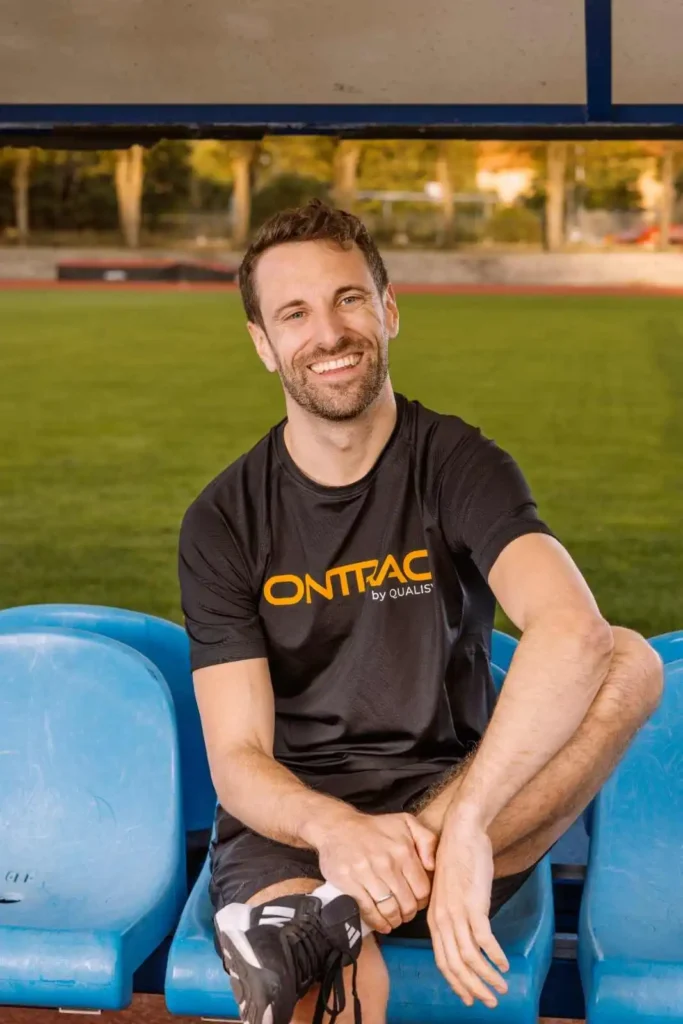
Long before Thomas Schneider was studying motion capture data, he was on the other end of a coach’s whistle. A former competitive gymnast, he spent years being corrected, pushed, and coached before he ever thought about coaching – or selling to – anyone else. Now, since joining Qualisys as OnTraq’s new Sales Director, that dual perspective shapes how he thinks about a gap he’s watched teams struggle with for years: the trade-off between precision and practicality.
“My passion for sport has always gone beyond performance itself,” he says. “I was equally driven by the desire to understand the underlying mechanisms of human movement and performance.”
That curiosity led him to a master’s degree in Sports Science, with a specialization in biomechanics, and from there into a decade driving growth in markerless motion capture technology within elite sport – working directly with athletes, coaches, and organizations to translate scientific insight into practical gains.
“What excites me most about this next step is the opportunity it represents,” he explains. “The precision that elite sport demands can finally meet the simplicity that teams need every day.”
Coached before he ever coached
It’s a detail he doesn’t lead with, but it shows: when he talks about what athletes and coaches actually need, it comes from someone who’s stood on both sides of that relationship. Ask what he’d be doing in another life, and gymnastics comes right back up. “If I hadn’t taken the career path I did, I probably would have become a professional gymnastics or athletics coach.” He still stays close to that world today, guest lecturing on motion capture and biomechanics at universities alongside his day job in sales – a mix he calls fairly unique, bridging scientific knowledge with the practical world of working directly with teams.
What a decade with teams taught him
That combination – athlete, scientist, and now sales professional – shaped one lesson that kept repeating itself across a decade on the commercial side of motion capture technology, helping professional teams weave it into their daily routines.
“These teams aren’t chasing more numbers,” he says. “They’re chasing clarity – something a coach can read in thirty seconds between two drills, not a report that needs a scientist to translate.” Elite programs, he adds, live under real-time pressure. “They need partners who understand both the science behind the data and the reality of a training week. That’s the gap I’ve always tried to sit in.”
The trade-off most teams have learned to accept
Ask Schneider what’s holding performance staff back today, and he points to a compromise the industry has quietly lived with for years.
“In performance testing, teams have had to pick one,” he says. “Either a simple test that any staff member can run without special equipment, or a proper biomechanical assessment that requires a lab, markers, and a trained biomechanist to interpret it correctly.”
Teams have typically leaned toward the simple option – it’s the only one most teams can actually access day to day. “No lab, no specialist standing by, anyone on staff can use it,” he says. “But that same simplicity is also its limitation. They were never built to capture the precision elite performance decisions really require.”
“What’s changed with OnTraq is that this trade-off no longer has to exist,” he says. “3D markerless tracking removes the barriers that kept biomechanical accuracy locked in the lab, and the data no longer requires a biomechanist to interpret – it’s translated into clear, actionable information any coach can use.”
“It’s not there to tell a coach how to coach,” he’s quick to add. “It’s there so the question has anything changed since last time? has a real answer, fast enough to actually be useful before a decision needs to be made, not after.”
Data doesn’t replace a coach’s eye – it sharpens it
For someone whose job is bringing motion capture technology to teams, Schneider is careful about overstating what data can do. “A coach has something that no dataset can replicate – experience, context, intuition, and a deep understanding of the individual player,” he says. “Data has a different role. It can make things visible that we cannot see on the pitch – confirm what the coach is feeling, challenge an assumption, or reveal a trend that might otherwise go unnoticed.”
That same instinct – knowing what not to overstate – comes through in how coaches describe working with him. Ask what surprises them, and it’s rarely his technical knowledge. “Most people are surprised that I’m not the typical sales guy who’s just there to hit numbers,” he laughs. “What they usually find instead is someone who really cares about the outcome, not just the movement and the biomechanics. I’m the kind of person coaches end up calling just to talk through a problem.”
What keeps him going
The athletes and coaches keep him energized, and so do the people he gets to do the work with. “I actually know part of the team from my previous work at Simi,” he says of joining Qualisys. “I felt genuinely welcomed from the very first day and was happy to reconnect with the team. It’s a great foundation, and I’m looking forward to building even more of those moments here.” It shows in the small things – like the fact that a friendly game of football after a video shoot doesn’t feel like an obligation.

Outside of work, Schneider is based in Munich with his wife and their ten-month-old daughter – an arrival, he says, that’s taught him a fair amount about patience and priorities. Free time these days mostly goes to staying active, wakeboarding or snowboarding depending on the season. He can still do a backflip from his gymnastics days, for what it’s worth.
Thomas is easy to find if you want to keep the conversation going, for an open chat about where elite sport is headed.