

A sprinter drives out of the blocks, and within seconds their stride exists as a rotating 3D skeleton on a screen, every joint angle measured, every frame reconstructed in space. That is 3D motion capture at work. So how does it work? At its core, the technology records the movement of a person or object with multiple sensors, then reconstructs that movement as three-dimensional digital data a computer can animate, measure, or analyze. What follows is the full pipeline, from raw movement to finished output.
What Is 3D Motion Capture?
Motion capture, often shortened to mocap, is the process of recording movement and translating it into digital data. A technical overview of motion capture describes it as tracking key points on a body or object over time and converting them into a usable digital record.
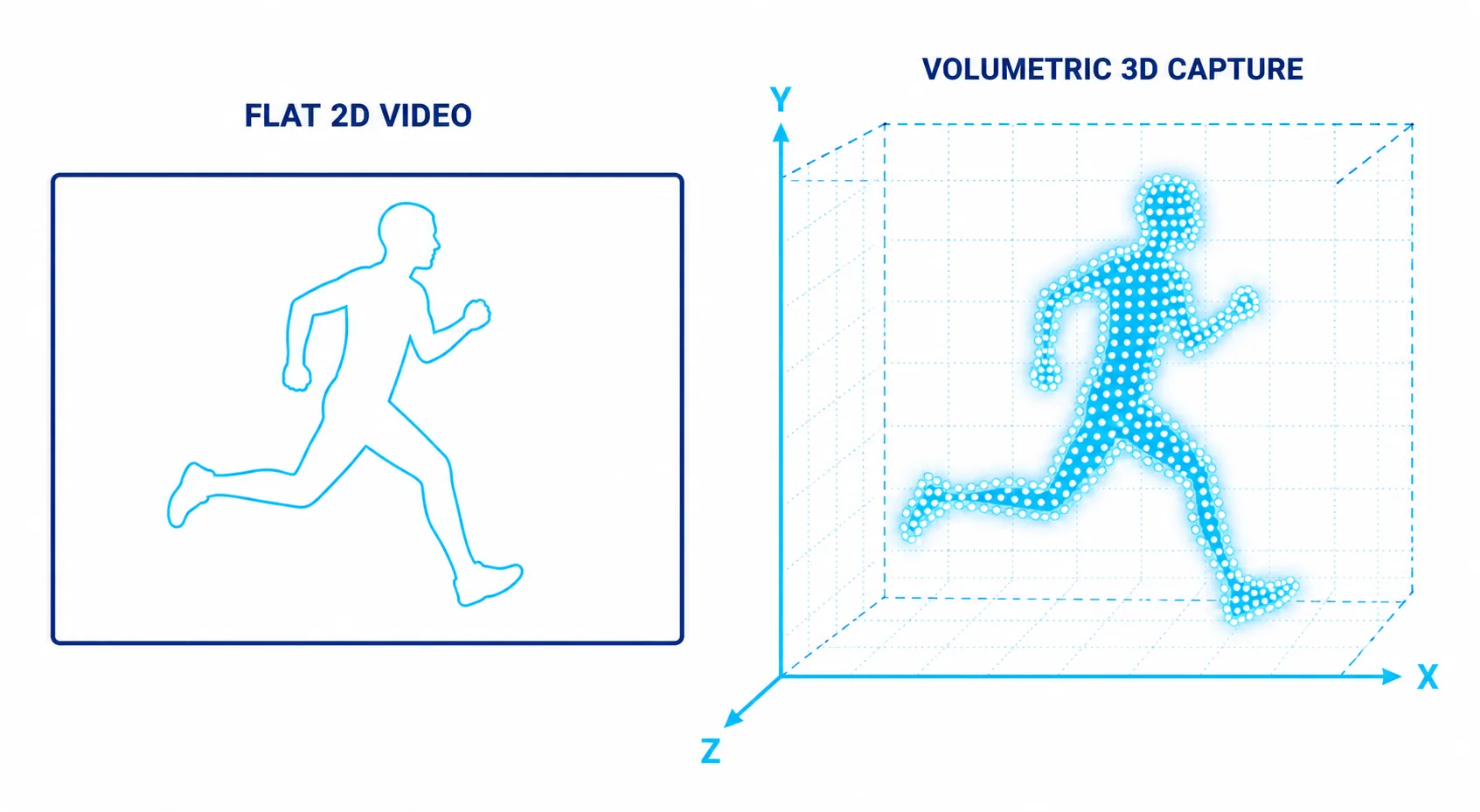
What makes it 3D is the dimensionality of that record. Ordinary video is flat: it captures movement across a two-dimensional frame. A 3D system captures position in three spatial axes, X, Y, and Z, producing three-dimensional motion capture data that changes over time as volumetric coordinates. Instead of a picture of a movement, you get a measurable model of it in space.
So what is a 3D motion capture system? It is an integrated stack of hardware and software: sensors or cameras to record, markers or a suit worn by the performer, capture software to process the signals, and a digital skeleton that movement is mapped onto. No single piece works alone, the system is the combination.
A Quick History, How Motion Capture Developed
The idea predates computers. Early animators used rotoscoping, tracing filmed footage frame by frame to reproduce lifelike motion by hand. The first true marker-based systems arrived with electronic sensors, letting researchers and studios record position data directly rather than tracing it.
Optical camera arrays followed, becoming the accuracy standard for film and laboratory work. The most recent leap is markerless capture driven by computer vision and AI, which extracts 3D motion from ordinary video. Across that arc, the defining shift has been speed: systems moved from painstaking offline processing to real-time capture, where a performer’s movement appears as a digital character or data stream almost instantly.
How Does 3D Motion Capture Work? The Core Mechanism
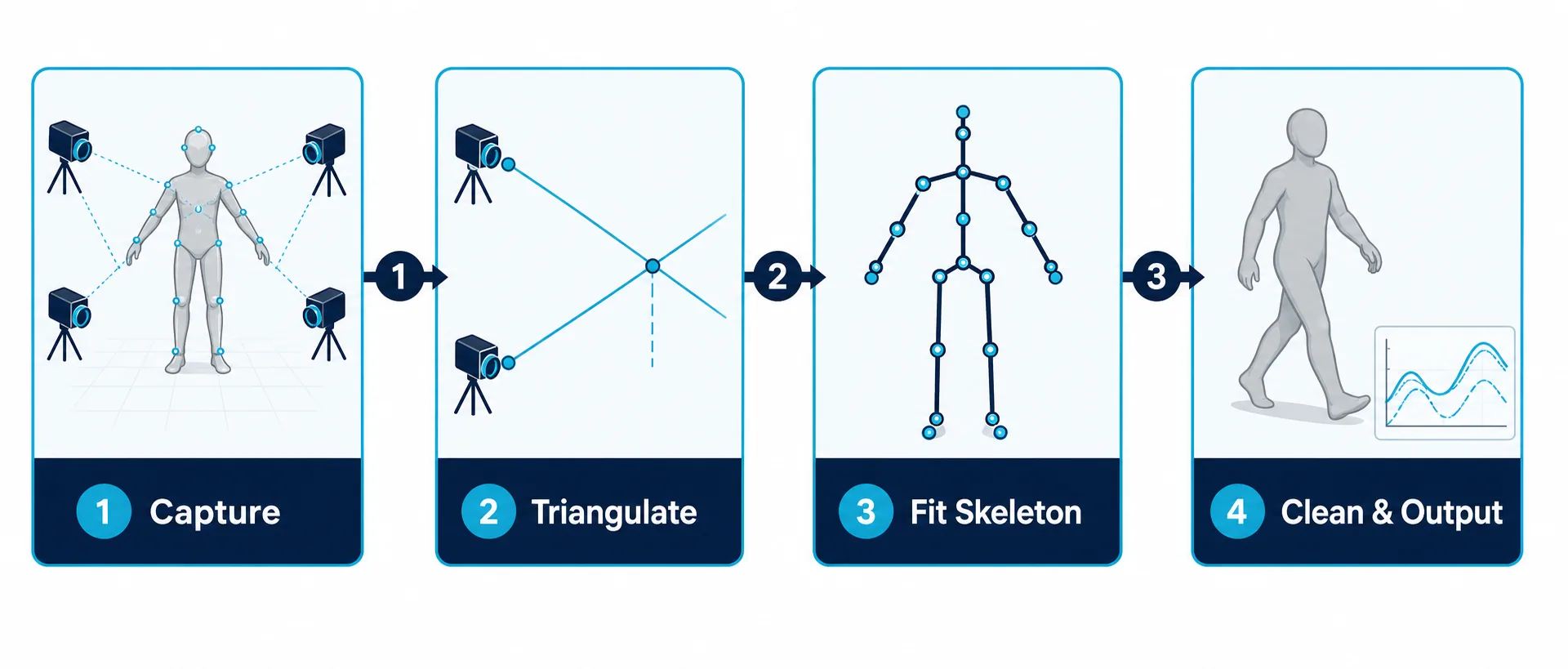
Whatever the hardware, the underlying process follows the same four steps.
Step 1, Capturing Movement
Several cameras or sensors observe the performer from different angles at once. Each camera records the 2D position of specific points, reflective markers on a suit, or, in markerless setups, recognizable body features like joints and limbs. Any single camera only sees a flat projection, so the system needs many viewpoints working together.
Step 2, Triangulation Into 3D Coordinates
Step 3, Labeling Markers and Fitting a Digital Skeleton
A cloud of points is not yet a body. The software identifies which point is which, left knee, right elbow, pelvis, and maps them onto a digital skeleton, or rig. Once markers are assigned to skeletal segments, the system calculates joint angles, segment lengths, and how each part rotates relative to the next. The data now describes a structured, articulated body rather than loose dots.
Step 4, Cleaning, Solving, and Output
Real capture is messy. Markers get briefly hidden, sensors introduce noise, frames drop. At this stage the software fills gaps, filters jitter, and solves the skeleton so movement stays smooth and anatomically plausible. The cleaned result is exported, into animation software to drive a character, or into biomechanics tools to produce charts of joint kinematics and loading. From here, the same 3D data can power a movie character or a coach’s technique report.
Instead of a picture of a movement, you get a measurable model of it in space.
Types of 3D Motion Capture Systems
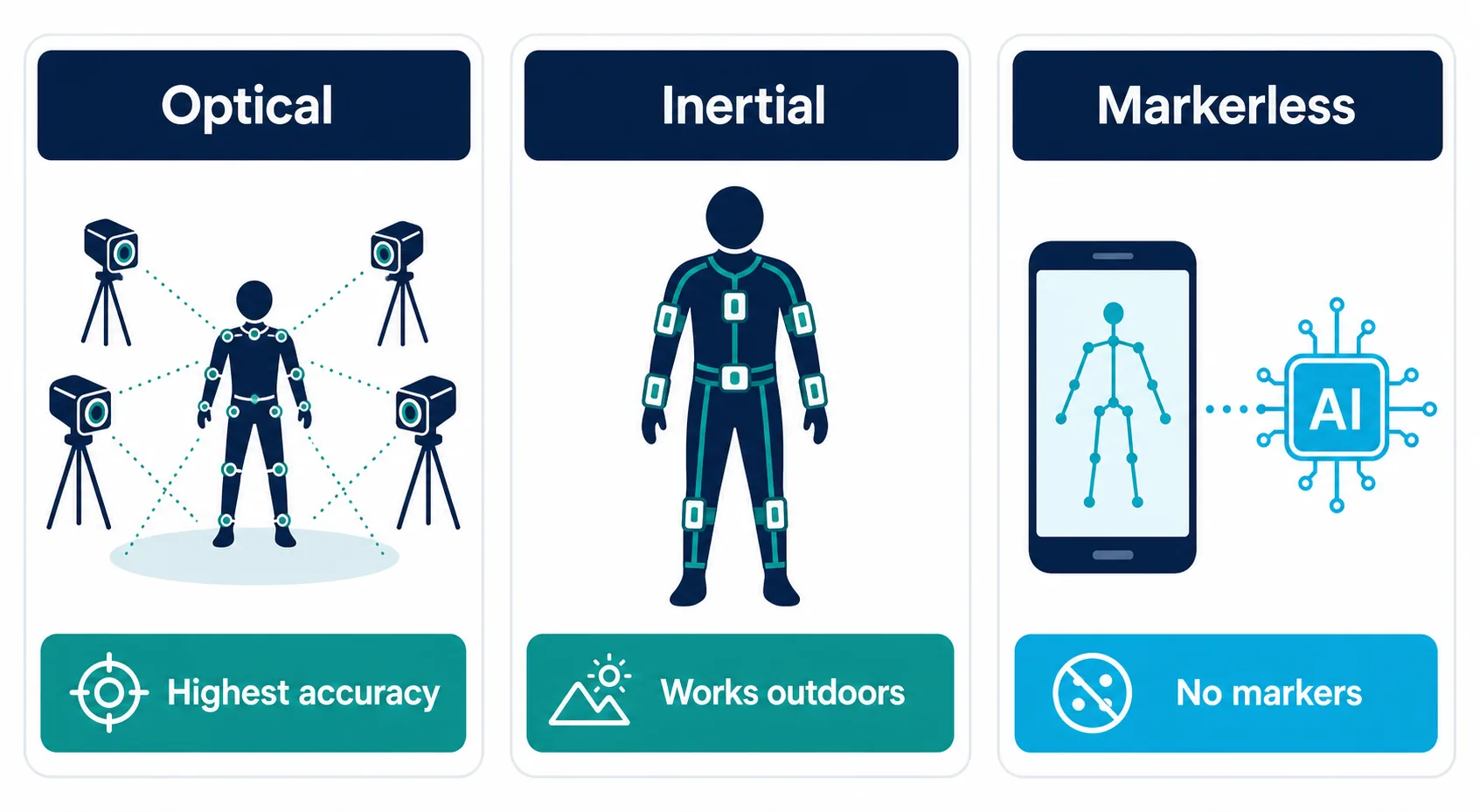
Three broad approaches dominate, each with its own trade-offs.
Optical (Marker-Based)
Optical systems use reflective or active markers tracked by an array of specialized cameras. They deliver the highest accuracy and remain the standard for film production and research labs. An overview of optical motion capture explains how these camera systems track key points in space and convert them into a precise 3D representation. The cost is setup: cameras must be mounted and calibrated, and markers need a clear line of sight.
Non-Optical / Inertial (Suit-Based)
Inertial systems embed small IMU sensors, accelerometers and gyroscopes, into a motion capture suit. Rather than being watched by cameras, each sensor reports its own orientation and motion. Because no external line of sight is required, an inertial suit works outdoors, on a real field, or in cramped spaces where cameras cannot see. The trade-off is drift over time and generally lower positional precision than a well-calibrated optical rig.
Markerless (Video + AI)
Markerless systems skip markers and suits entirely. Computer-vision models perform pose estimation on ordinary video, inferring joint positions and reconstructing 3D motion, part of the AI-driven shift now reshaping the field. The appeal is obvious: a phone or a couple of cameras replaces a dedicated studio. A companion piece examines how close markerless gets to lab systems across gait, jumping, and clinical assessments. Accuracy and validation remain the open questions, and a review of markerless motion capture for clinician-scientists lays out the validation standards this approach still needs to meet for research and clinical use.
| System | Strength | Trade-off |
|---|---|---|
| Optical (marker-based) | Highest accuracy, standard for film and research labs | Cameras must be mounted and calibrated; markers need clear line of sight |
| Inertial (suit-based) | Portable, works outdoors and in cramped spaces, no line of sight needed | Drift over time and lower positional precision than optical |
| Markerless (video + AI) | Convenience and low cost, a phone or a couple of cameras replaces a studio | Accuracy and validation remain open questions |
In short: optical wins on accuracy, inertial on portability, and markerless on convenience and cost, with the accuracy gap narrowing.
What Equipment Is Needed for Motion Capture?
The practical kit depends on the system type, but a working 3D setup generally needs:
- Cameras or IMU sensors, an array of tracking cameras for optical, or body-worn inertial sensors for suit-based capture.
- Markers or a suit, reflective markers for optical systems, or a sensor-embedded suit for inertial.
- Calibration tools, a wand or reference object used to teach the system exactly where each camera sits.
- A capture volume, the physical space, sized and cleared so the performer can move freely within camera view.
- A workstation and capture software, enough computing power to process, solve, and record the data.
- A digital skeleton or rig, the template the captured points are mapped onto.
Two calibration steps are easy to overlook. First, the system is calibrated so software knows each camera’s precise position and angle. Then the performer is calibrated, a brief range-of-motion capture that scales the digital skeleton to that individual’s proportions. Skip either, and the 3D reconstruction degrades. For teams weighing how a modern integrated stack fits together, Ontraq’s approach to motion capture reinvented for performance settings shows how these components are being packaged for real-world use.
What Is Motion Capture Used For?
The same core pipeline serves very different fields.
Film and Animation
Mocap gives animators photoreal, human-driven character movement. The performer most widely associated with performance capture is Andy Serkis, whose work as Gollum in The Lord of the Rings and Caesar in the Planet of the Apes films made the technique famous.
Video Games
Game studios use mocap to make player and character movement feel natural, sprinting, tackling, climbing, reacting, rather than animating each motion by hand. Real-time capture also speeds production by letting directors see performances on a digital character immediately.
Sports Performance and Biomechanics
This is where 3D motion capture earns its keep as a measurement tool. Coaches and sports scientists use it to break down technique frame by frame, quantify joint loads to screen for injury risk, and track objective markers during return-to-play. Instead of a subjective eye on a movement, staff get numbers, hip flexion angles, ground-contact timing, asymmetries between limbs, that turn coaching hunches into evidence. It is this quantitative depth, documented across the sports motion capture literature, that separates 3D mocap from ordinary video review. Curious what that looks like in a real session? Our explainer on how sports biomechanics testing works walks through a complete athlete workup.
Clinical and Rehabilitation (Gait Analysis)
Clinical gait labs use 3D capture to measure how patients walk, quantifying joint kinematics to guide treatment and rehab. A 3D motion capture camera system used for gait analysis shows how reconstructed joint data supports assessment of movement disorders, surgical planning, and recovery tracking.
The Pros and Cons of Motion Capture
Mocap is powerful, but not free of trade-offs, and the cons matter as much as the benefits.
Pros:
- Highly realistic, human-driven movement.
- Rich quantitative data, angles, velocities, loads, not just imagery.
- Real-time feedback in many systems.
- Reusable data that can be retargeted to different characters or analyses.
Cons:
- Optical and lab systems carry significant cost.
- Calibration and setup take time and expertise.
- Marker occlusion, a hidden marker, creates gaps that need cleanup.
- Traditional systems often demand a controlled environment.
- Data cleaning and solving is labor that follows every session.
- Interpreting the output well requires trained staff.
The right question is rarely “is mocap good?” but “which system fits the accuracy, budget, and setting I actually have?”
The Future, Markerless and AI-Driven Capture
The trajectory is toward capture that is portable, camera-only, and increasingly automated. AI pose estimation is lowering the barrier that once confined 3D mocap to well-funded studios and labs, opening it to smaller teams and on-field sports settings where a full optical rig was never practical. As validation catches up to convenience, real-time analysis on the sideline moves from exceptional to routine, the direction Ontraq’s sports-technology work is built around.
Frequently asked questions
What is a 3D motion capture system?
What equipment do you need for motion capture?
What are the disadvantages of motion capture?
Who is the most famous motion capture actor?
Is markerless motion capture accurate enough for sports and clinical use?
From a performer’s movement, to 2D camera data, to triangulated 3D coordinates, to a solved skeleton ready for animation or analysis, that is the pipeline behind every mocap character and every biomechanics report. Of all its uses, sports performance and clinical biomechanics are where 3D motion capture is most actionable today, turning raw movement into measurements a team can act on.