

Can I trust the numbers? Performance directors and sport scientists ask that before anything else, and the answer is more useful than a single figure on a spec sheet. Camera-only movement measurement is strong in some places, weaker in others, and its error behaves predictably once you know what drives it.
What follows is a measurement piece: error magnitudes by joint and plane, the setup factors that move them, and how to interrogate an accuracy claim from any supplier.
The Short Answer on Accuracy
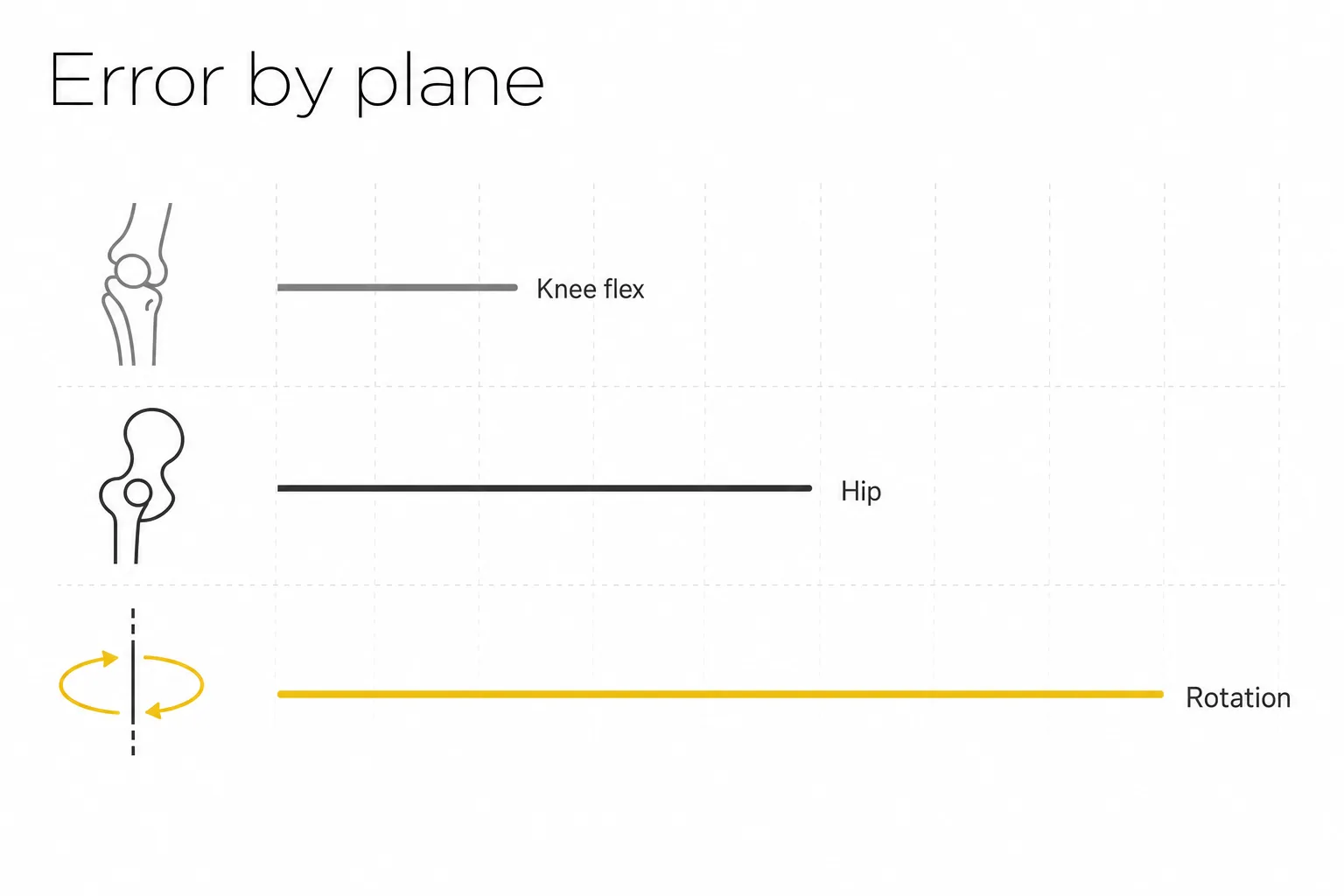
Accuracy is not one number. It varies by joint, by plane of motion, by how fast the task is, and by how the cameras are set up. A system that agrees closely with a reference lab during walking will not carry that agreement into a sprint or a cutting task.
The pattern in published comparisons is consistent. Flexion and extension at the knee and ankle show the closest agreement with marker-based reference systems. Hip measures show wider differences. Frontal and transverse plane rotations (abduction and adduction, internal and external rotation) show the largest differences and the most variability between systems. Position errors for tracked body points, reported separately from angle errors, land in the low tens of millimeters for well-configured multi-camera setups.
For a performance team the useful question is not “is this as accurate as a research lab?” It is “is this accurate and repeatable enough for the decision I am about to make?” Those are different tests, and most team decisions depend far more on repeatability than on absolute agreement with a lab.
Accuracy, Repeatability, and Agreement Are Not the Same Thing
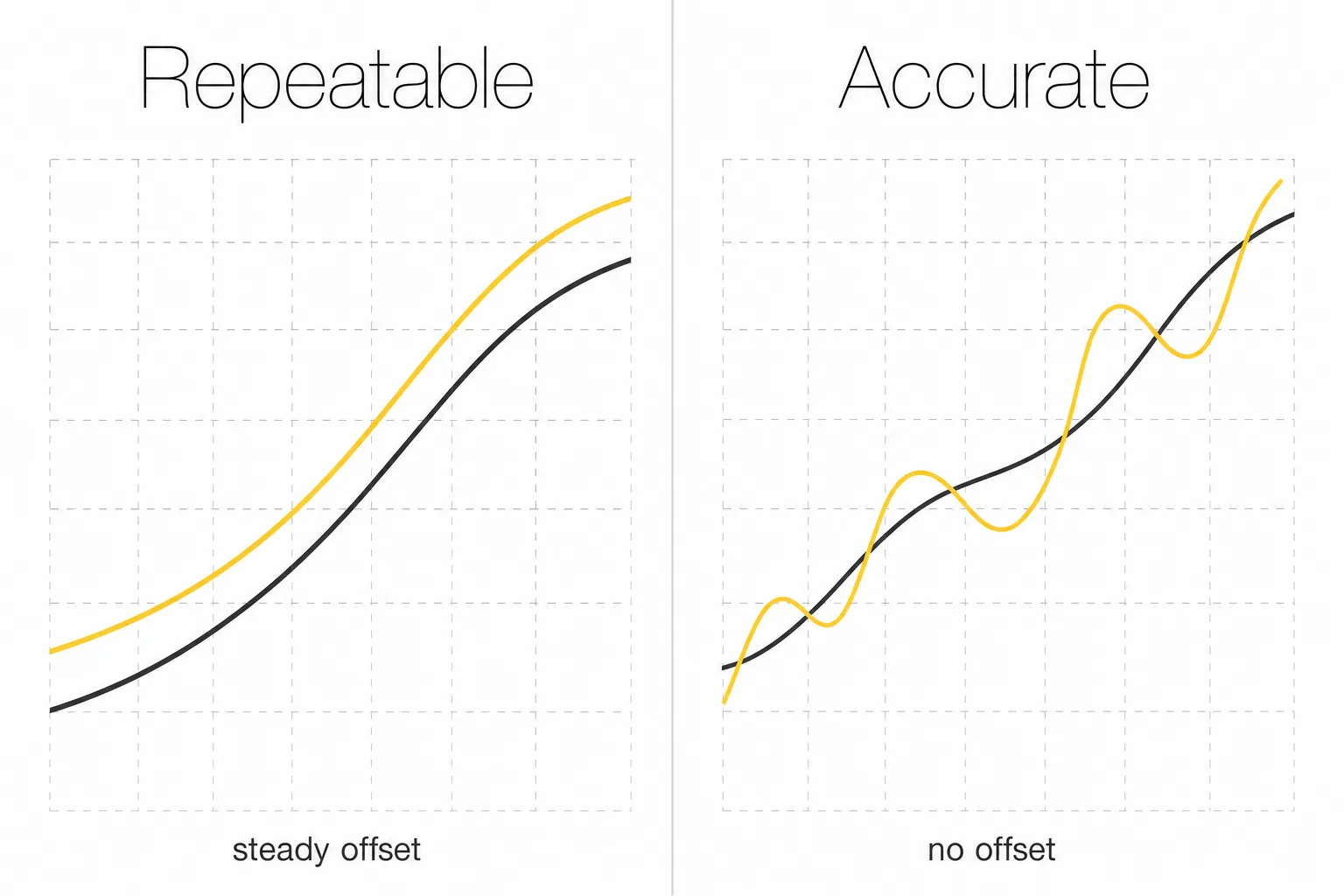
These three words get used interchangeably in marketing material, and they mean different things.
Accuracy is closeness to a reference value. Repeatability (also called reliability) is whether the system gives you the same answer on Tuesday that it gave you last Tuesday, with a different staff member running the session. Precision describes the spread of repeated measures around their own mean, regardless of whether that mean is correct.
A system can be repeatable without being accurate. If it reports knee flexion four degrees higher than a reference lab every single time, it is inaccurate but perfectly usable for tracking an athlete against their own history.
Accuracy studies report a handful of statistics:
| Metric | What It Measures | Units |
|---|---|---|
| RMSE / RMSD | Overall size of the gap between two systems across a full movement, the headline number in most papers | Degrees (angles) or millimeters (positions) |
| Mean absolute difference | The average size of the gap, less sensitive to occasional large errors than RMSE | Degrees or millimeters |
| Bland-Altman limits of agreement | Both the systematic offset and how widely individual measurements scatter around it | Degrees or millimeters |
| Correlation / CMC | How closely the shape of a curve matches between systems. High correlation does not mean small error | Unitless, 0 to 1 |
| ICC (intraclass correlation coefficient) | How consistently two systems or two sessions rank the same measurements relative to each other. Above roughly 0.75 is good, above 0.9 is excellent | Unitless, 0 to 1 |
| Minimum detectable change | The smallest shift that exceeds the system’s own measurement noise. Comes from repeatability testing, not agreement with a lab | Degrees or millimeters |
That last one carries a trap. High correlation does not mean small error. Two curves can rise and fall in near-perfect step while sitting several degrees apart the whole way. Read the absolute difference alongside the correlation.
The number that matters most for ongoing testing is minimum detectable change: the smallest shift that exceeds the system’s own measurement noise. Below that threshold, a change in an athlete’s report is noise. Above it, something has genuinely changed. Any team building a baseline program needs this number, and it comes from repeatability testing, not from agreement with a reference lab.
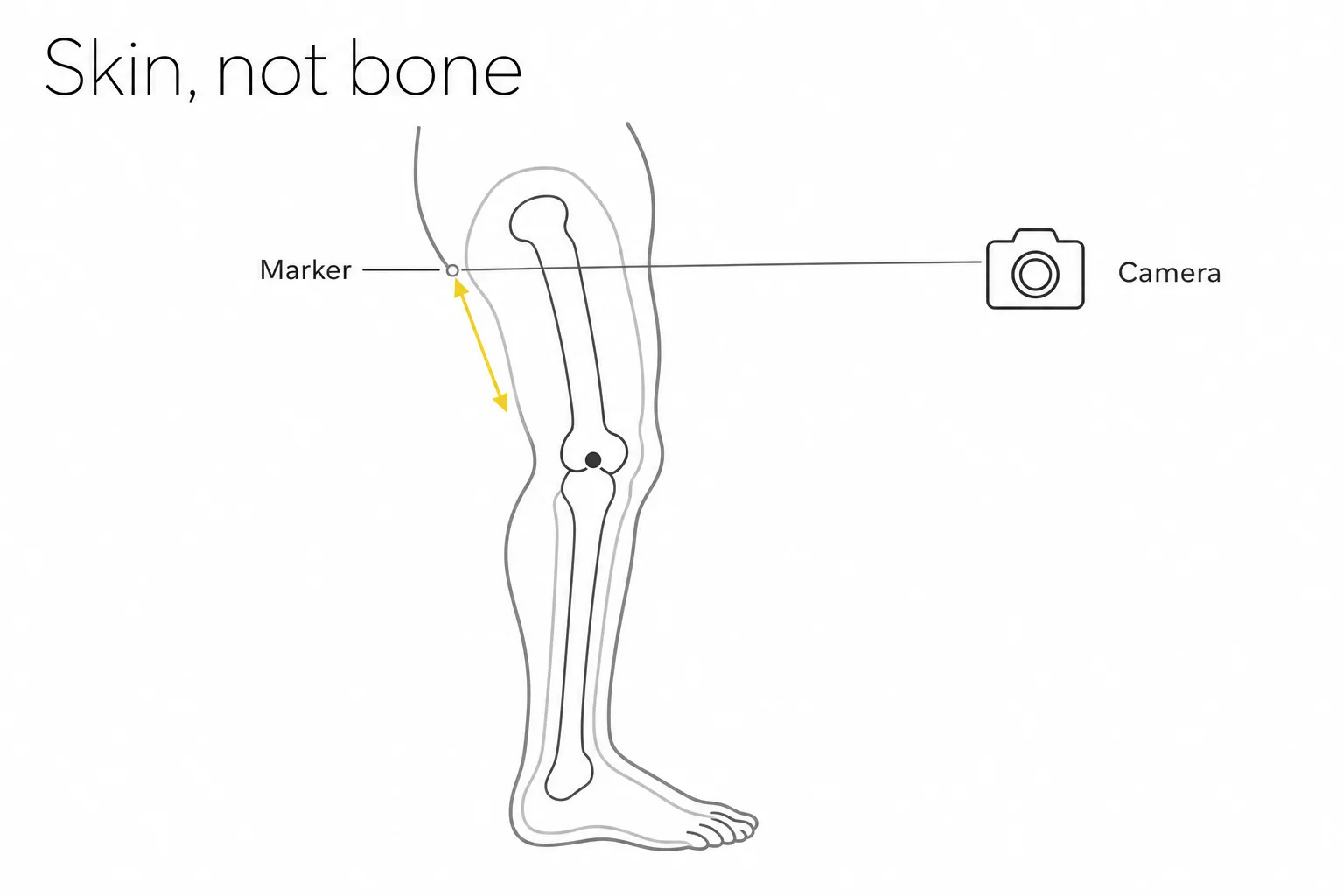
No optical system, with markers or without, measures bone motion directly. Both approaches estimate the skeleton beneath the skin from what a camera can see on the outside.
That is worth keeping in mind before treating any system as ground truth. Our explainer on how camera-based movement analysis works covers the underlying method.
Markerless Motion Capture Accuracy vs. Marker-Based Systems
Marker-based optical capture earned its reference standard status honestly. Reflective markers tracked by infrared cameras give a well-defined, directly observed point in space, and decades of biomechanics research rest on that foundation. What the status guarantees is a high-quality, well-understood measurement. What it does not guarantee is a perfect one.
Across published work on gait, running, squatting, and jump-landing tasks, camera-only systems track the large sagittal plane movements of the lower limb closely, and diverge as joints get deeper, rotations get smaller, and movements get faster. Our wider review of what the research shows about camera-based movement analysis sets out that evidence base.
Joint angle agreement in the sagittal plane
Knee and ankle flexion and extension are where camera-only systems perform best. These are large-amplitude rotations, often spanning 60 degrees or more through a gait or squat cycle, and both the joint axis and the segments on either side of it are clearly visible in an image.
The physical reason is straightforward. A fixed measurement error consumes a small share of a large signal. Two degrees of error against 70 degrees of knee flexion is a rounding difference. The same two degrees against a 10-degree rotation is a serious problem.
Hip flexion and extension agreement is generally good but sits wider than at the knee and ankle. The hip joint centre cannot be seen at all. It is estimated from surface landmarks and body dimensions, and different estimation methods place it in slightly different spots.
Where agreement drops: frontal and transverse plane
Abduction and adduction, and internal and external rotation, are the weak point for every camera-based approach.
Two things work against them. The rotations are small, so a modest absolute error becomes a large relative error. And the visual cues that indicate rotation, such as the twist of a thigh segment, are subtle on the surface of the body compared with the obvious hinge of a knee bending.
The practical guidance follows. Treat out-of-plane rotations as trend indicators within one system rather than absolute values you can compare against a published norm or another supplier’s output. If an athlete’s frontal plane knee measure moves consistently across three sessions on the same system with the same setup, that trend is worth investigating. Comparing that absolute value against a number from a different system is not meaningful.
The hip and pelvis are the hardest region overall, for the same reason: deep joint centres are estimated rather than seen, and the surrounding tissue moves a great deal.
Keypoint and segment position error
Position error is reported separately from angle error, and it is the number most suppliers prefer to quote because it looks small. It describes how far a tracked body point sits from where a reference system placed it.
Well-configured multi-camera video setups have produced position errors in the low tens of millimeters in peer-reviewed work. A peer-reviewed evaluation of 3D markerless motion capture using OpenPose with multiple synchronized video cameras, found that roughly 47% of mean absolute errors were under 20 mm and 80% were under 30 mm, though about 10% exceeded 40 mm, mostly from tracking failures rather than measurement noise.
Millimeters and degrees do not convert cleanly into each other. A 20 mm position error at the end of a long segment produces a modest angular error. The same 20 mm error at a short segment, or at a point close to a joint centre, produces a much larger one. When a supplier quotes millimeters, ask what that translates to in degrees at the joints you care about.
The reference standard has its own error
Some of the measured difference between the two approaches belongs to the marker-based system.
Markers sit on skin, and skin slides over bone. This is soft tissue artifact, a documented source of error in marker-based measurement, most pronounced at the thigh and pelvis, where the most tissue sits between the marker and the bone underneath. High-impact and high-speed tasks make it worse.
Marker placement adds a second source. Two staff members palpating the same landmark will place a marker in slightly different positions, and the same person will place it differently on different days. That between-operator and between-day variation is a recognized limitation of the reference standard itself.
So a difference between a camera-only system and a marker-based lab is not automatically an error in the camera-only system. It is a disagreement between two estimates, both carrying uncertainty. Our side-by-side comparison of the two approaches works through the trade-offs in full.
What Actually Changes the Error Bar
Accuracy figures are not properties of a technology. They are properties of a technology in a specific setup, running a specific task. Knowing what moves the error lets you prevent bad data rather than accept a supplier’s number on faith.
| Factor | Why It Matters | Quick Fix |
|---|---|---|
| Camera count and placement | More synchronized views resolve depth and rotation that a single view can’t | Fixed installation with planned camera geometry, not an improvised setup |
| Occlusion, clothing, environment | Every occluded moment is estimated, not observed; loose kit blurs the outline the software fits to | Fixed testing zone, written kit policy, consistent lighting |
| Frame rate and synchronization | Low or inconsistent frame rates blur fast segments and shift peak timing | Hardware-synchronized cameras, fixed filter settings across sessions |
| Movement speed and task complexity | Walking and controlled squats agree tighter than sprinting, cutting, and landing | Standardize the task: same movement, same instructions, same tempo every session |
| Skeleton model and scaling | A model fitted to the athlete’s own dimensions reduces systematic offset versus a stretched generic template | Ask the supplier how the model is scaled and how joint centres are defined |
Camera count, placement, and viewing angle
More camera views reduce ambiguity. A single view cannot resolve depth or rotation reliably, so the software infers what it cannot see. Adding synchronized views from different angles removes that guesswork.
Viewing angle matters as much as count. Views oriented square to the primary plane of motion produce lower error than oblique ones, which is why a fixed installation with planned camera geometry outperforms an improvised setup.
Single-camera and phone-based capture sit in a different accuracy category. They can be useful for coaching feedback on movements that stay in one plane. They cannot resolve out-of-plane rotation the way a synchronized multi-camera array can.
Capture volume and camera height decide whether the whole movement stays in frame. A jump that leaves the top of the volume, or a stride that exits the side of it, produces incomplete data no matter how good the software is.
Occlusion, clothing, and environment
Self-occlusion is the everyday enemy. During a deep squat the thigh hides the shank. During a crossover cut one leg passes behind the other. Arm swing hides the torso outline. Every occluded moment is a point the system estimates rather than observes, and estimated points carry more error.
Clothing matters more than most teams expect. Loose kit, baggy shorts, and long sleeves blur the body outline the software is fitting a skeleton to. A consistent kit policy is one of the cheapest accuracy improvements available.
Environment does the rest. Changing light levels, reflective floors, and busy backgrounds all degrade image quality. A practical checklist: a fixed testing zone, a written kit policy, consistent lighting. Three decisions, made once, that protect every session afterwards.
Frame rate, resolution, and synchronization
Low or inconsistent frame rates blur fast-moving segments and shift the apparent timing of peak angles. If you are measuring peak knee flexion during a landing, frame timing is the difference between capturing the peak and missing it.
Hardware synchronization across cameras matters more for fast tasks than raw resolution does. If views are even slightly out of step, the software is reconstructing a body that was in different positions in different images.
Consumer webcams and phone cameras introduce rolling shutter effects and variable frame timing, both of which add noise that no amount of processing fully removes.
Filtering deserves its own note. Smoothing reduces noise, but aggressive filtering also flattens genuine peaks. Whatever the settings are, they must stay fixed between sessions. Changing a filter setting mid-program silently breaks every trend you have built.
Movement speed and task complexity
Walking and controlled squats produce tighter agreement than sprinting, cutting, and landing. A 2023 Journal of Biomechanics study comparing markerless and marker-based estimates across eight common movements found that knee and ankle agreement stayed strong even during running and a run-and-cut maneuver, with root mean square differences under 6 degrees.
The hip joint was the exception: differences ranged from about 7 to nearly 16 degrees, and the gap widened specifically during the faster tasks.
Peak values suffer more than averages. A mean angle across a full cycle smooths out individual frame errors. A single peak value inherits all of them.
The implication for protocol design is direct: standardize the task. Same movement, same instructions, same tempo, every session. When the task is fixed, the error stays comparable session to session, and comparable error is what makes trend data trustworthy.
Related readingHow Does 3D Motion Capture Work? A Clear GuideRead the guide →| Joint / Plane | Task | Typical Agreement |
|---|---|---|
| Knee, ankle flexion-extension | Walking, squatting | Closest agreement, RMSD often under 6 degrees |
| Hip flexion-extension | Walking, squatting | Good, but wider than knee and ankle |
| Hip, all planes | Running, cutting | Widest gap of the sagittal-plane measures, RMSD roughly 7 to 16 degrees |
| Abduction/adduction, internal/external rotation | Any task | Least reliable across every joint. Treat as a within-system trend, not an absolute value |
| Tracked point position (multi-camera) | General | Roughly 20 to 30 mm for most points in well-configured setups |
The skeleton model and how it is scaled
This is the part most buyers never ask about, and it explains more disagreement than anything else.
Two separate accuracy problems stack on top of each other. First, pose estimation locates body points in an image. Second, a biomechanical model turns those points into joint angles. A system can be excellent at the first and mediocre at the second.
How the model is scaled matters. A skeleton fitted to an individual athlete’s actual body dimensions reduces systematic offset compared with stretching a generic template to roughly the right height. Athletes are not scaled copies of one another.
Suppliers also define joint centres and segment coordinate systems differently. Two systems can both be internally consistent, both repeatable, and still disagree by several degrees on the same movement, purely because they define the joint differently. That is not a fault in either one, but it does mean their outputs are not interchangeable.
Ask any supplier which model they use and how joint centres are defined. If the answer is that the method is proprietary and cannot be described, that is a meaningful answer in itself.
For Team Testing, Repeatability Beats Absolute Accuracy
Most accuracy content misses the point for performance staff. You are rarely trying to match a research lab. You are trying to get the same answer next Tuesday.
If a system carries a consistent offset, that offset cancels out when you compare an athlete against their own baseline. Four degrees high in March and four degrees high in September still show the change between March and September correctly. The offset never enters the decision.
What breaks longitudinal tracking is variability, not offset. A different operator. Cameras moved between sessions. A changed processing setting. Different marker placement, in the marker-based case. Each introduces a shift that has nothing to do with the athlete and everything to do with the measurement.
A method that is slightly less accurate but perfectly consistent, and that any trained staff member can run, produces better decisions than a highly accurate method that only one specialist can operate and that runs three times a year.
This is why a fixed installation, automatic movement detection, and an identical processing pipeline every session improve decision quality more than a marginal gain in absolute accuracy would.
Practically, set a change threshold before you start. Test a group of athletes twice under identical conditions, look at the spread of the differences, and set your threshold above that noise floor. Anything smaller is measurement variation. Anything larger is worth a conversation.
Limitations You Should Plan For
Camera-only measurement has real boundaries, and knowing them is part of using it well.
- Out-of-plane rotations and small-amplitude joints remain the weak point. Build reporting around measures you can trust and treat the rest as supporting context.
- Cameras measure movement, not forces. Ground reaction forces and joint loads require force plates or an integrated setup.
- The capture volume is fixed. High-speed field actions over long distances will not fit inside a testing space.
- Results are not portable between systems. Different model definitions mean switching suppliers resets your baseline history. Plan for a fresh baseline if you change platforms.
- It is not a substitute for coaching judgement or clinical assessment, and it is not a diagnostic tool. It provides objective measures that inform a decision a qualified person still makes.
- The accuracy evidence base is task-specific and still growing. A result published for gait does not transfer to a cutting task.
- Most published evidence is on healthy adults. Validation in youth athletes, older adults, and clinical or post-injury populations is growing but thinner. If your squad includes academy-age players or athletes returning from surgery, ask a supplier what populations their validation studies actually covered.
The Advantages That Follow From Removing Markers
The accuracy conversation only makes sense alongside what removing markers buys you.
No marker placement removes the largest source of operator-to-operator variability in optical measurement. The step that most affects between-session consistency simply does not exist.
Athletes test in normal training kit, so the measurement does not change the movement. Nobody adjusts their gait because of a sensor taped to their shin.
Testing time drops from many minutes per athlete to about 90 seconds, which is the difference between testing a squad once a season and testing it monthly. Denser data makes real change easier to separate from noise, because you have more points to establish what normal looks like for that athlete.
And because there is no placement protocol to learn, any trained staff member can run a session. No specialist required, no bottleneck when that specialist is travelling with the team.
How to Judge an Accuracy Claim From a Supplier
Use this when a number lands in front of you.
- Which task produced it? Walking numbers do not describe jumping or cutting.
- Which joints and which planes? Ask for the full results table, not the best row.
- Is it position error in millimeters or angle error in degrees? They are not interchangeable, and millimeters always sound better.
- What is the between-session and between-operator repeatability? For anything longitudinal this matters more than agreement with a reference lab. Many suppliers cannot answer it.
- How many cameras, at what frame rate, in what space? A figure from an optimal lab setup does not describe your gym.
- Is the study peer-reviewed, independent, and published, or internal? Both can be honest. They carry different weight.
- How are joint centres defined, and can raw data be exported? If you can export it, you can run your own checks.
If you want a structured way to run through these questions, the Sports Technology Research Network published a Quality Framework for sports technologies in 2023, built with 48 experts across science, engineering, and performance. It groups 25 measurable features into five areas: reliability, established benefit, ethics and security, user experience, and data management.
It wasn’t built for motion capture specifically, but the reliability and established-benefit sections map closely onto the questions above, and it gives you a vocabulary for comparing suppliers that isn’t set by any single vendor’s marketing.
One signal is worth more than any single figure: a supplier who tells you where their system is weaker is giving you more usable information than one quoting a headline number with no context.
How Much Accuracy Does Your Use Case Actually Need?
Map the requirement to the decision instead of chasing a universal number.
Squad-wide baseline screening and trend monitoring. Repeatability is the dominant requirement. A small consistent offset is tolerable because every comparison is athlete-versus-self. What you need is a known change threshold and identical conditions every session. Before setting those numbers, it helps to know which variables an athlete assessment tracks and what each one tells practitioners.
Return-to-play criteria and limb symmetry. The bar rises. You need defensible, documented, operator-independent measures, a change threshold you can explain to a physician, and a clear record of how each measurement was taken. Sagittal lower limb measures and symmetry ratios computed within one system are appropriate here. Absolute frontal plane values compared against external norms are not.
Technique work with an individual athlete. Sagittal joint angles are reliable enough to guide coaching cues and to show an athlete what changed between two attempts.
Research-grade joint loading, prosthetics fitting, or surgical planning. This still belongs in a marker-based laboratory, and that is the honest boundary. Camera-only systems and marker-based labs answer different questions. One gives you frequent, consistent measurement of a whole squad. The other gives you the highest available fidelity on one participant at a time. They are complements, not competitors.
How OnTraq Approaches Accuracy
OnTraq is built around the repeatability argument above rather than around a single headline figure.
Eight synchronized cameras run in a fixed, calibrated installation, so camera geometry does not drift between sessions. The skeleton model is scaled to each athlete’s own body dimensions rather than stretched from a generic template, which reduces systematic offset at the individual level.
Movement detection is automatic, and the processing pipeline is identical every session, which removes the operator as a variable. The same athlete, tested by two different staff members, goes through the same procedure.
A test takes about 90 seconds per athlete, roughly 20 athletes in 30 minutes. That is what makes repeat testing realistic during a warm-up or cool-down rather than a once-a-season event.
The system is built on Qualisys’ foundation of biomechanical accuracy, with four decades of optical measurement work behind it. Worth stating plainly: Qualisys marker-based systems and OnTraq serve different jobs. Lab-grade marker-based work remains the right tool for research questions that require it.
For teams that want force measurements alongside movement data, force plate integration is available. Reports show joint angles and positions, comparison against the athlete’s own baseline, and trends over time, held in secure cloud storage that performance and medical staff can access.
Frequently asked questions
What affects markerless motion capture accuracy the most?
How accurate is motion capture overall?
What are the key differences between camera-only and marker-based methods?
Is it accurate enough for return-to-play decisions?
Does the number of cameras change accuracy?
Can phone-based capture match a multi-camera system?
How often should a team retest to build a usable trend?
Does clothing affect results?
Turning Accuracy Into Decisions
The practical summary: sagittal plane lower limb measures are strong, out-of-plane rotations need care and should be read as trends rather than absolute values, and repeatability is what turns any of it into a decision you can defend.
One timing note. Installation, calibration, and staff training happen before a baseline testing window opens, which for most Northern Hemisphere programs puts the conversation in the off-season rather than mid-campaign.
To see the measurements, the reports, and the repeatability data applied to your own athletes, start with what OnTraq does and how it works, then book a demo and judge whether the numbers hold up for your setup.