

For decades, reflective markers were the only credible route to lab-grade 3D kinematics. If you wanted joint angles you could trust, you placed dozens of small spheres on an athlete’s skin and surrounded them with infrared cameras. That is changing. AI-driven markerless systems now promise much of the same insight from ordinary video, without the setup burden or the skin markers. If the technology itself is new to you, start with what markerless motion capture is before weighing the trade-offs.
Neither approach is universally “better.” The right choice depends on how much accuracy you need, where you’re capturing, what you can spend, and how the data fits your workflow. Reviewing markerless capture applications helps clarify whether the accuracy you need is already within reach. This article walks through how each method works, sets them side by side, summarizes what peer-reviewed validation studies actually show, and offers a practical framework for choosing between them.
What Is Marker-Based Motion Capture?
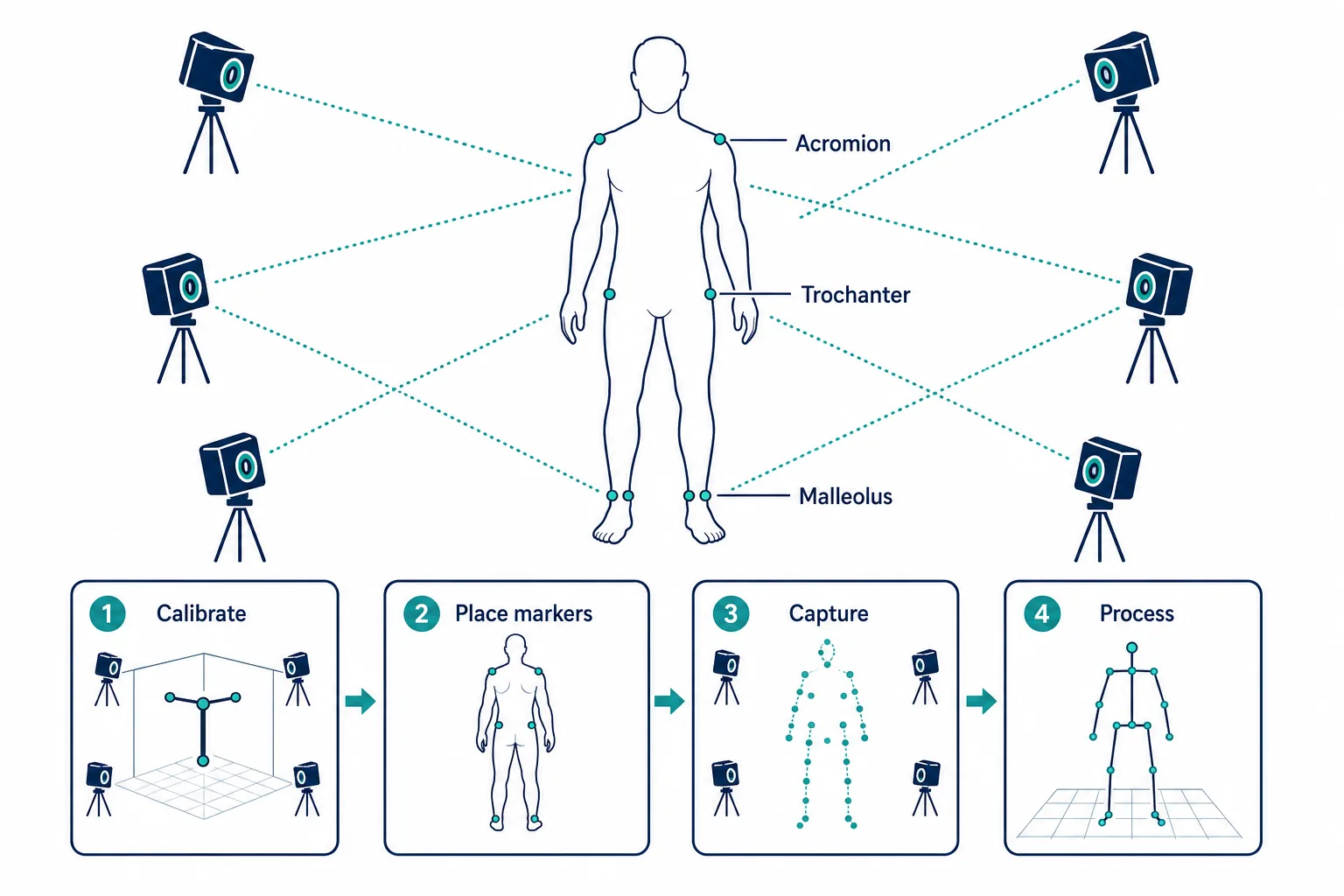
Marker-based motion capture places retro-reflective markers on anatomical landmarks, the lateral malleolus, greater trochanter, acromion, and tracks them with an array of synchronized infrared or optoelectronic cameras. Each camera detects the bright reflections, and the system reconstructs each marker’s position in 3D space through triangulation across multiple views.
A typical session follows a set sequence. The system is calibrated so every camera shares a common coordinate frame. A trained operator then places the marker set on the participant, palpating bony landmarks to position each marker correctly. A static trial establishes the neutral pose, dynamic trials capture the movement itself, and post-processing handles gap-filling, where markers briefly disappear from view, and labeling each marker to its anatomical identity.
Done well, established optoelectronic systems achieve sub-millimeter positional accuracy under controlled conditions, which is why marker-based capture became the reference standard in biomechanics. When a new method is validated, it is almost always compared against this benchmark, an approach used in an early PLOS ONE comparison of markerless and marker-based capture that treated the marker-based system as ground truth. That long track record is part of why these systems remain the yardstick for accuracy.
What Is Markerless Motion Capture?
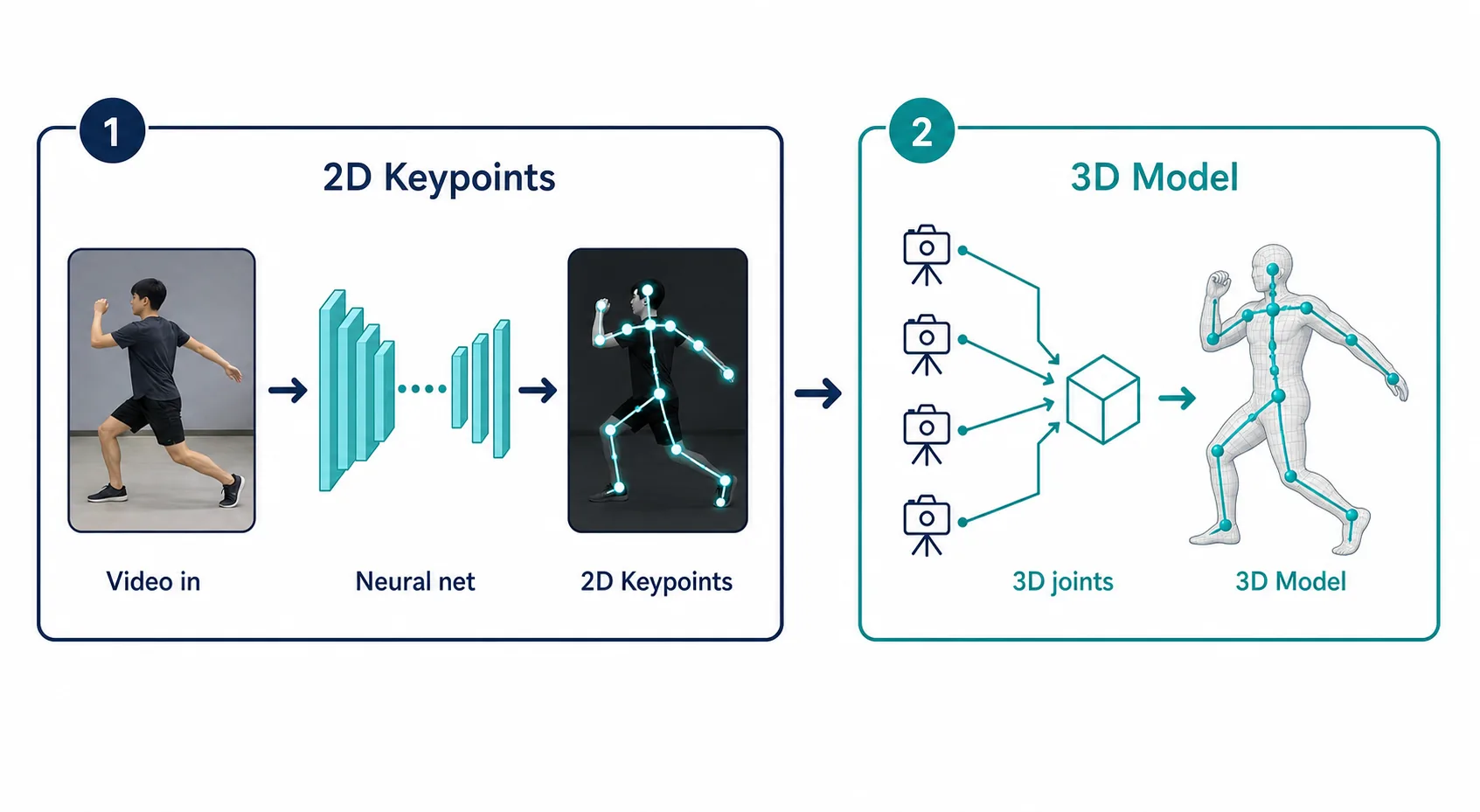
Markerless motion capture removes the physical markers entirely. Instead, it uses computer vision and deep-learning pose estimation to infer body position directly from standard, synchronized video. There is nothing to attach to the participant.
The pipeline typically works in two stages. First, a trained neural network detects 2D anatomical keypoints, joint centers and landmarks, in each camera’s image. Then those 2D detections from multiple viewpoints are combined and fitted to a biomechanical model to reconstruct 3D joint positions and angles. Deep-learning research pipelines popularized this workflow for movement science, applying neural networks to multi-camera video without a single marker on the body.
The data differences are meaningful. There is no marker placement and no palpation, which removes one source of human error, but the method now depends on the quality of its training data, the assumptions baked into its pose model, and adequate camera coverage of the movement. A comprehensive 2024 evaluation in Frontiers in Computer Science examined how marker-based and markerless methods stack up across a range of tasks, underscoring that markerless accuracy is tightly linked to how, and how well, the underlying models were trained. Markerless capture trades the physical burden of markers for a dependence on software, models, and camera geometry.
Markerless vs Marker-Based: The Core Differences at a Glance
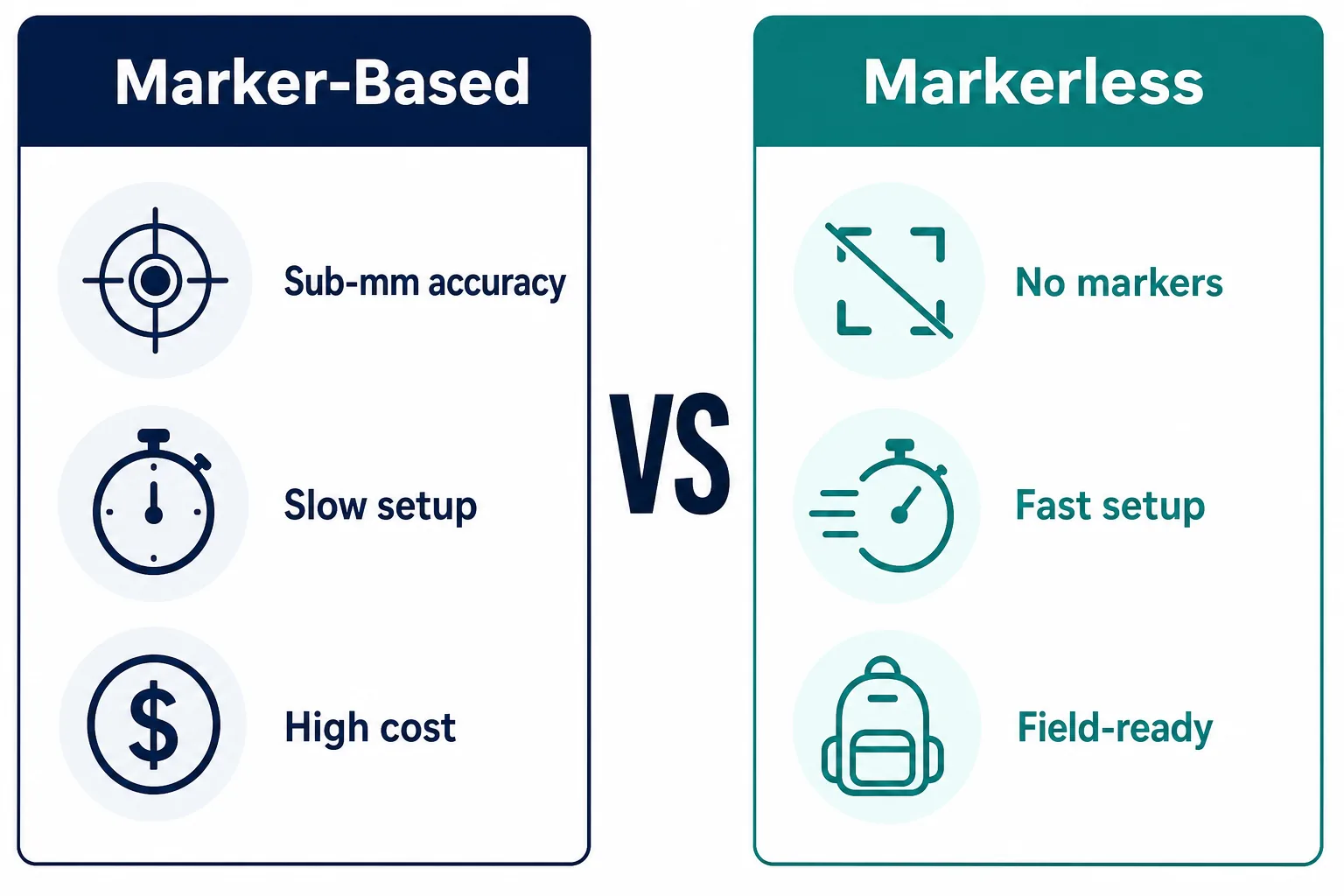
Use this to orient, then read the sections below for the nuance behind each row. We unpack the validation evidence behind these numbers in a standalone article for anyone who wants the source studies.
| Dimension | Marker-Based | Markerless |
|---|---|---|
| Accuracy / validity | Reference standard; sub-millimeter under controlled conditions | Strong for gross kinematics; larger gaps on fine and off-sagittal-plane measures |
| Inter-trial variability | Generally lower within a session | Can be higher within a session |
| Inter-session variability | Sensitive to marker-placement error between sessions | Often lower, no markers to re-place |
| Setup & prep time | Slow; expert marker placement per subject | Fast; no markers to attach |
| Cost | High capital cost (camera arrays, lab space, operators) | Generally lower; leans on software and cameras |
| Subject comfort / ecological validity | Markers on skin; lab-bound | No markers; tolerant of normal clothing and settings |
| Data processing | Gap-filling and labeling required | Compute-intensive pose estimation |
| Environment | Controlled lab | Lab, field, court, or clinic |
| Best-fit applications | Precision multi-planar kinematics, research rigor | Throughput, field capture, longitudinal tracking |
Accuracy and Validity: What the Studies Show
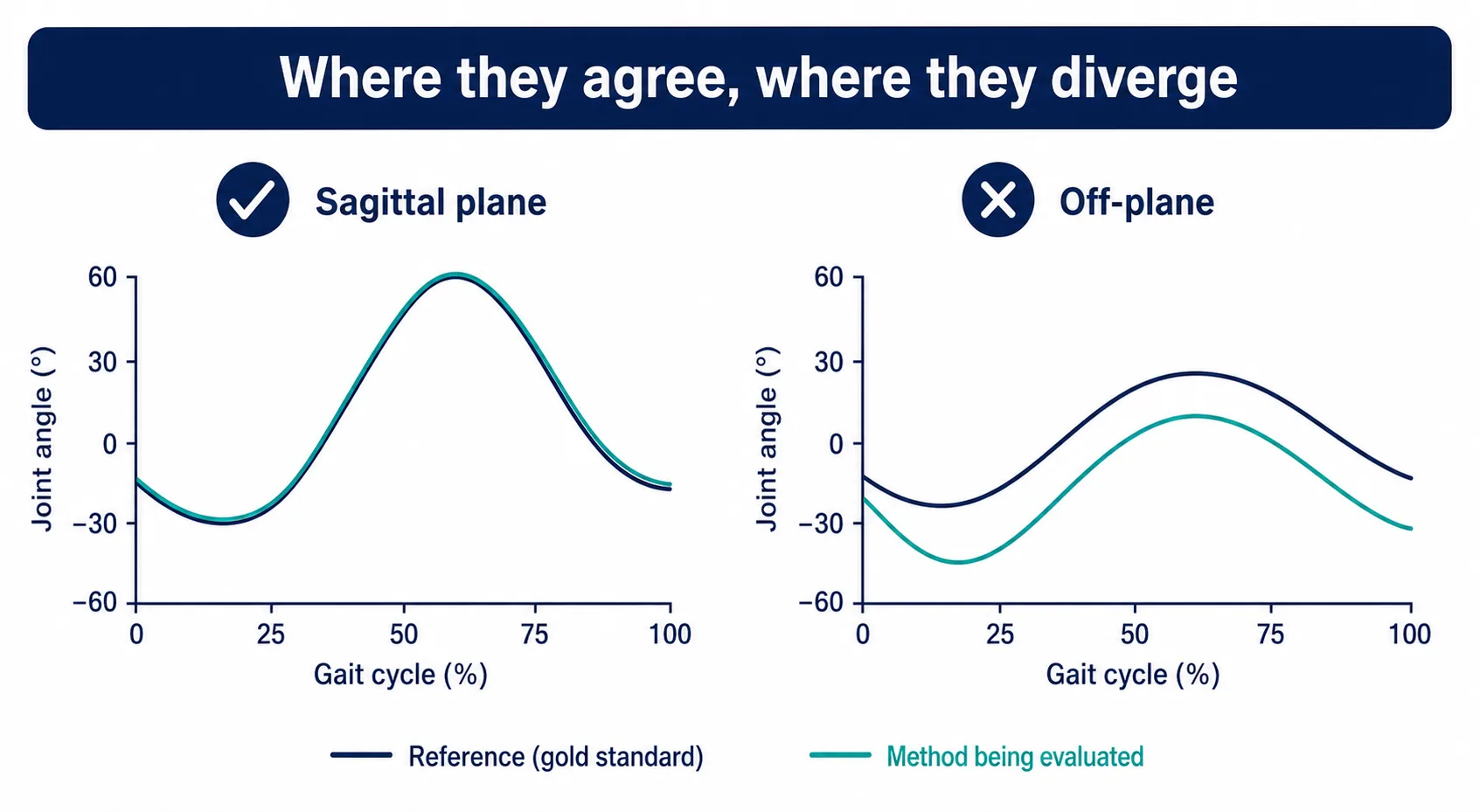
Accuracy is where the comparison gets interesting, because the answer is not a single number, it depends heavily on which movement and which plane you measure.
Where the two agree
For gross, large-amplitude motion, the two methods tend to line up well. Whichever system you choose, our piece on measuring joint angles and asymmetry in athletes shows what a complete screen should report. Sagittal-plane joint angles, knee and hip flexion during gait, for example, and overall movement patterns often show good agreement between markerless and marker-based data. A kinematic-signal comparison published in the Journal of Biomechanics found that the broad shape of many kinematic curves is preserved between the two approaches, which is why markerless is frequently described as a promising alternative for this class of measurement.
Where they diverge
The agreement narrows as movements get smaller or leave the sagittal plane. Transverse and frontal-plane rotations, precise joint-center estimation, and fine distal movements are consistently harder for markerless systems to match. Hand and finger analysis is a clear example: the small segments and dense articulation that make finger movement so information-rich also make it difficult for pose-estimation models to resolve reliably, and validation work on these fine movements shows wider discrepancies than gross lower-limb tasks. A thesis from Georgia Southern University comparing the two systems reinforces the pattern that discrepancies grow for the more demanding, detail-sensitive measures.
Markerless is a genuine alternative, but not yet a one-to-one replacement for every kinematic variable.
The practical takeaway: if your analysis lives in the sagittal plane and cares about overall patterns, the gap may be immaterial. If it hinges on subtle rotations or small segments, the gap still matters.
Variability: The Reliability Question
Accuracy answers “is it close to the truth?” Reliability answers “does it give me the same answer twice?”, and here the two methods swap advantages depending on what you measure.
Inter-trial variability
Within a single session, markerless data can show greater variability from trial to trial. Work in the Journal of Biomechanics on inter-trial variability reported that inter-trial variability was higher in 3D markerless capture than in the marker-based comparison. If you’re averaging many trials, this noise partly washes out; if you’re interpreting single efforts, it’s worth accounting for.
Inter-session variability
Between sessions, the picture can flip. Marker-based reliability is hostage to marker placement: put a marker a few millimeters off next week and the joint model shifts with it. Markerless has no markers to re-place, so it can be more repeatable across days and weeks. A change-of-direction study indexed in PubMed reported that the markerless system showed minimal inter-session variation and remained unaffected by clothing, a real advantage for tracking an athlete across a season.
The nuance that shallow comparisons miss: “more variable” and “more repeatable” can both be true of the same markerless system at once. It may wobble more between trials in a session yet hold steadier between sessions. Which property matters depends entirely on your study design, single-effort analysis versus longitudinal monitoring.
Setup, Workflow, and Ecological Validity
The day-to-day experience of the two methods is very different, and for applied sport that difference often decides the question.
Marker-based capture is labor-intensive. Someone has to place the marker set correctly, which takes expertise and time per subject, and palpation error creeps in whenever a landmark is hard to find. The reflective markers and camera geometry effectively tether the capture to a dedicated lab.
Markerless capture strips most of that away. There is no marker placement, prep is faster, nothing sits on the skin, and the method tolerates athletes wearing normal clothing. That combination makes it far easier to capture movement in natural settings, on the field, on the court, or in a clinic, which raises ecological validity. Instead of asking an athlete to perform a controlled approximation of a sprint or a cut inside a lab, you can capture the real movement in the environment where it happens, in their normal kit. For a sports-technology audience, that ability to measure genuine sprinting, change-of-direction, and jumping under representative conditions is often the whole point.
Cost and Accessibility
Cost shapes who can realistically adopt each method. Marker-based systems carry a high capital cost: arrays of specialized cameras, dedicated and often light-controlled lab space, and skilled operators to run sessions and clean data. That combination puts full marker-based labs out of reach for many teams and smaller clinics.
Markerless capture generally lowers the barrier to entry. It leans more on software and can work with more standard cameras, so the up-front hardware investment tends to be smaller and the footprint more flexible. But “cheaper” is not “free.” Markerless shifts cost from hardware to compute and software, pose estimation is processing-heavy, and it still demands good camera coverage and sensible placement to work well. Under-camera a capture volume and accuracy suffers regardless of how good the model is. The convenience-and-cost trade-off is real, but it is a trade-off, not a free lunch.
Which Should You Choose? (Decision Framework)
Rather than crowning a winner, match the method to the job.
Choose marker-based when
You need reference-standard precision, especially for fine or multi-planar kinematics, small segments, subtle rotations, joint-center accuracy. It’s the safer choice when the work carries research or regulatory rigor, when you’re validating another method against a benchmark, and when your capture happens in controlled lab conditions where the setup overhead is acceptable.
Choose markerless when
You prioritize throughput and want to capture more athletes in less time; when subject comfort and normal clothing matter; when the movement belongs on a field or court rather than in a lab; when you’re tracking the same athlete longitudinally and value session-to-session repeatability; and when a lighter setup burden and lower entry cost open the door to work you otherwise couldn’t do.
Hybrid, and where the field is heading
Many labs don’t choose exclusively. They run markerless for the volume and convenience while periodically validating it against a marker-based reference, using each method for what it does best. That hybrid posture reflects the trajectory: markerless is closing the accuracy gap as pose-estimation models improve, and measures that were shaky a few years ago are increasingly usable. The direction of travel is clear even where marker-based still holds the edge on the most demanding variables.
Frequently asked questions
Is markerless motion capture as accurate as marker-based?
Where can I find peer-reviewed comparisons (studies or PDFs)?
Can markerless replace marker-based systems entirely?
Does clothing or skin markers affect the results?
The Bottom Line
The markerless-versus-marker-based decision is application-driven, not a contest with a single winner. Marker-based capture keeps its edge where precision is paramount, fine, multi-planar kinematics under controlled conditions, and remains the benchmark others are measured against. Markerless capture has grown from a research curiosity into a practical tool that delivers faster setup, greater athlete comfort, field-ready ecological validity, and strong session-to-session repeatability, at a lower barrier to entry. As pose-estimation models keep improving, the measures where markerless can stand in for the reference standard will only expand. The most useful question isn’t which method is best in the abstract, but which one fits the movement you need to measure, the environment you need to measure it in, and the decisions that data will inform.