

A Plain-English Guide to Capturing Movement Without Suits or Sensors
Markerless motion capture records 3D human movement using ordinary video cameras and AI software, with no suit, reflective markers, or wearable sensors attached to the body. Sports scientists, clinicians, coaches, and animators are adopting it because it strips the setup out of movement analysis and lets people move naturally. This guide covers what markerless mocap is, how it works, how accurate it really is, what it’s used for, and where it’s heading. If you are choosing between systems rather than learning the basics, compare markerless and marker-based capture side by side.
What is markerless motion capture?
Markerless motion capture measures how a person moves by feeding standard video into computer-vision software that identifies the body and tracks it through space. “Markerless” is literal: nothing is fixed to the participant. That is the core contrast with traditional marker-based mocap, where technicians attach dozens of reflective markers or a sensor suit and record them with specialized infrared cameras.
The distinction matters most in research and clinical settings, where measurement quality is scrutinized. A 2022 review of what clinician-scientists need to know about markerless mocap frames it as a serious candidate for the future of motion analysis, precisely because it removes the marker-placement step that makes marker-based capture slow and skill-dependent.
How does markerless motion capture work?
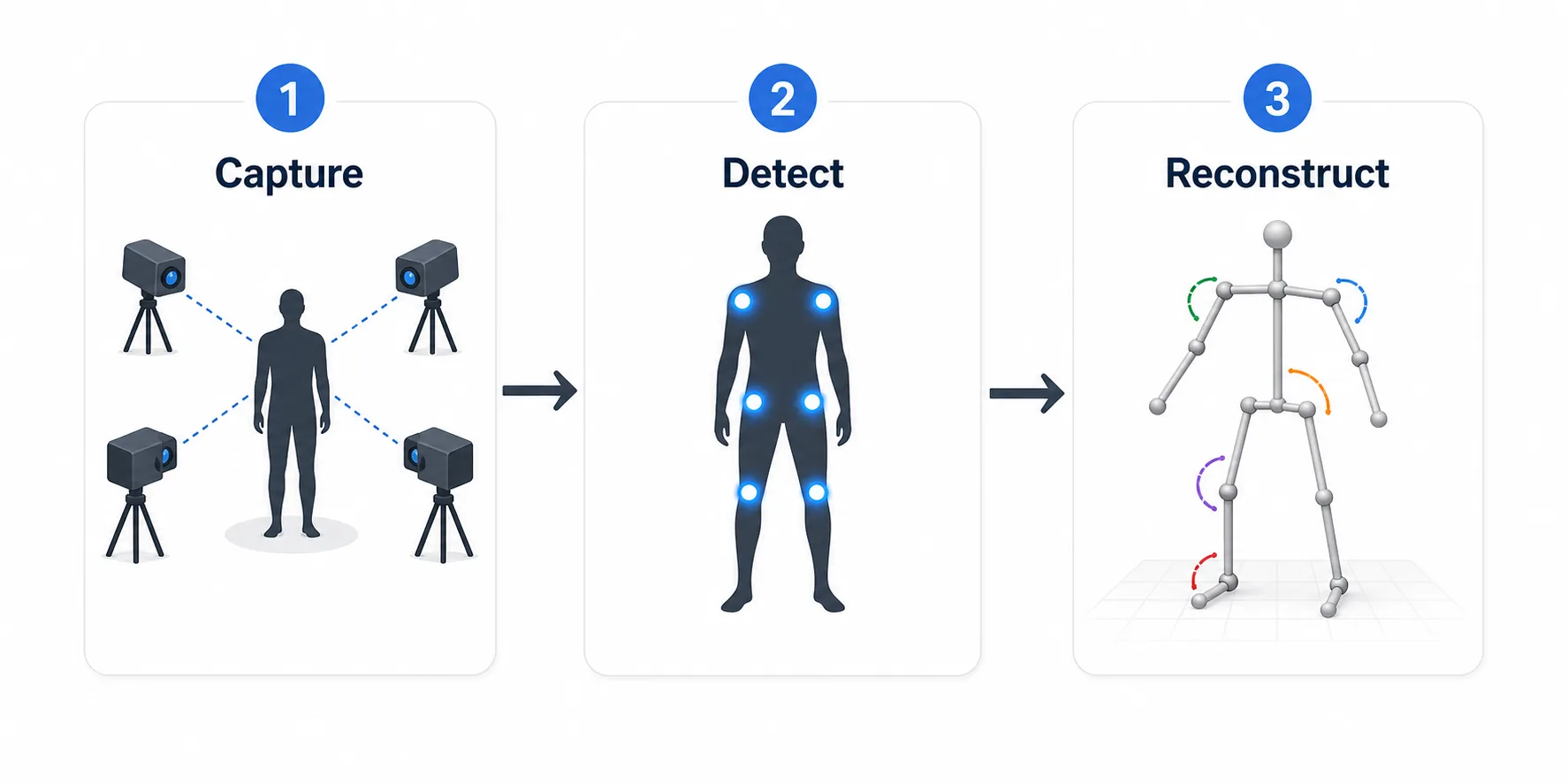
The pipeline runs in three broad stages.
Capture
One or more synchronized video cameras record the movement. A research lab might use eight to twelve calibrated cameras around a capture volume; a field or clinic setup might use two or three; some consumer tools work from a single smartphone. More viewpoints generally mean better 3D reconstruction.
Detect
Deep-learning pose-estimation models scan each frame and locate anatomical landmarks such as hips, knees, ankles, shoulders, and wrists. These neural networks were trained on large datasets of labeled human images, which is where the “AI” in markerless mocap lives. The software infers joint positions from pixels rather than from physical markers.
Reconstruct
The system triangulates the detected landmarks across camera views to build a 3D skeleton, then fits a biomechanical model to output joint angles, segment positions, and velocities over time. Researchers have shown these steps can be chained into a fully automated markerless pipeline that takes raw video and returns biomechanical data with little manual intervention, which is a large part of the appeal.
Markerless vs. marker-based motion capture
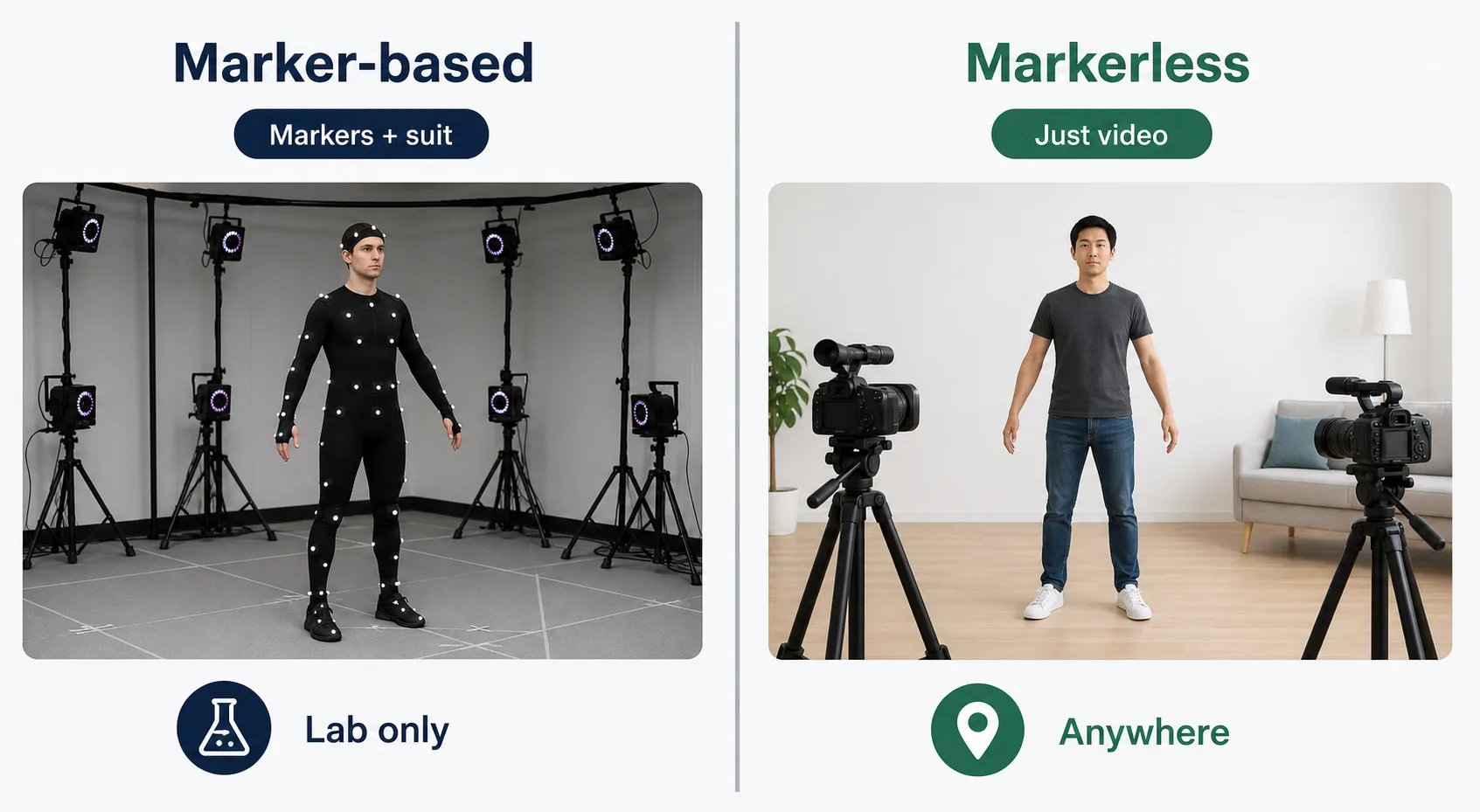
The trade-off is worth stating plainly, because it decides whether the technology fits your work.
| Factor | How it compares |
|---|---|
| Setup time | Marker-based capture requires careful marker placement on each participant; markerless skips it. |
| Participant burden | No suit or markers means people wear normal clothing and move without feeling instrumented, which improves natural movement. |
| Environment | Markerless is easier to run outside a dedicated lab, including on a court, field, or clinic floor. |
| Cost and access | Camera-and-software systems can be cheaper and more portable than full infrared marker rigs. |
| Accuracy | Marker-based mocap is still treated as the laboratory gold standard for precision. |
Head-to-head testing supports a nuanced picture. A 2023 comparison of markerless and marker-based systems in Scientific Reports found strong agreement for many measures while flagging where differences persist. That is roughly the consensus: markerless trades some precision for speed, scale, and ecological validity.
How accurate is markerless motion capture? (kinematics)

Kinematics describes movement itself, the joint angles, segment positions, and velocities, without reference to the forces causing it. It’s the metric most people mean when they ask whether markerless is “good enough.”
The evidence is encouraging and task-dependent. Agreement with marker-based systems is strongest for large, sagittal-plane joint angles such as hip and knee flexion during walking. We pull the published findings together in a dedicated guide to markerless motion capture accuracy. A study of markerless estimates of lower-extremity kinematics reported close tracking of major gait angles while noting that smaller, transverse-plane rotations show more variability. Feasibility work such as a 2022 study in Frontiers in Human Neuroscience reached similar conclusions for three-dimensional analysis: usable for many applications now, with accuracy improving quickly.
The practical takeaway: match the method to the question. Large-joint gait or sprint mechanics are well within reach; fine rotational detail warrants more caution and validation.
What is markerless motion capture used for?
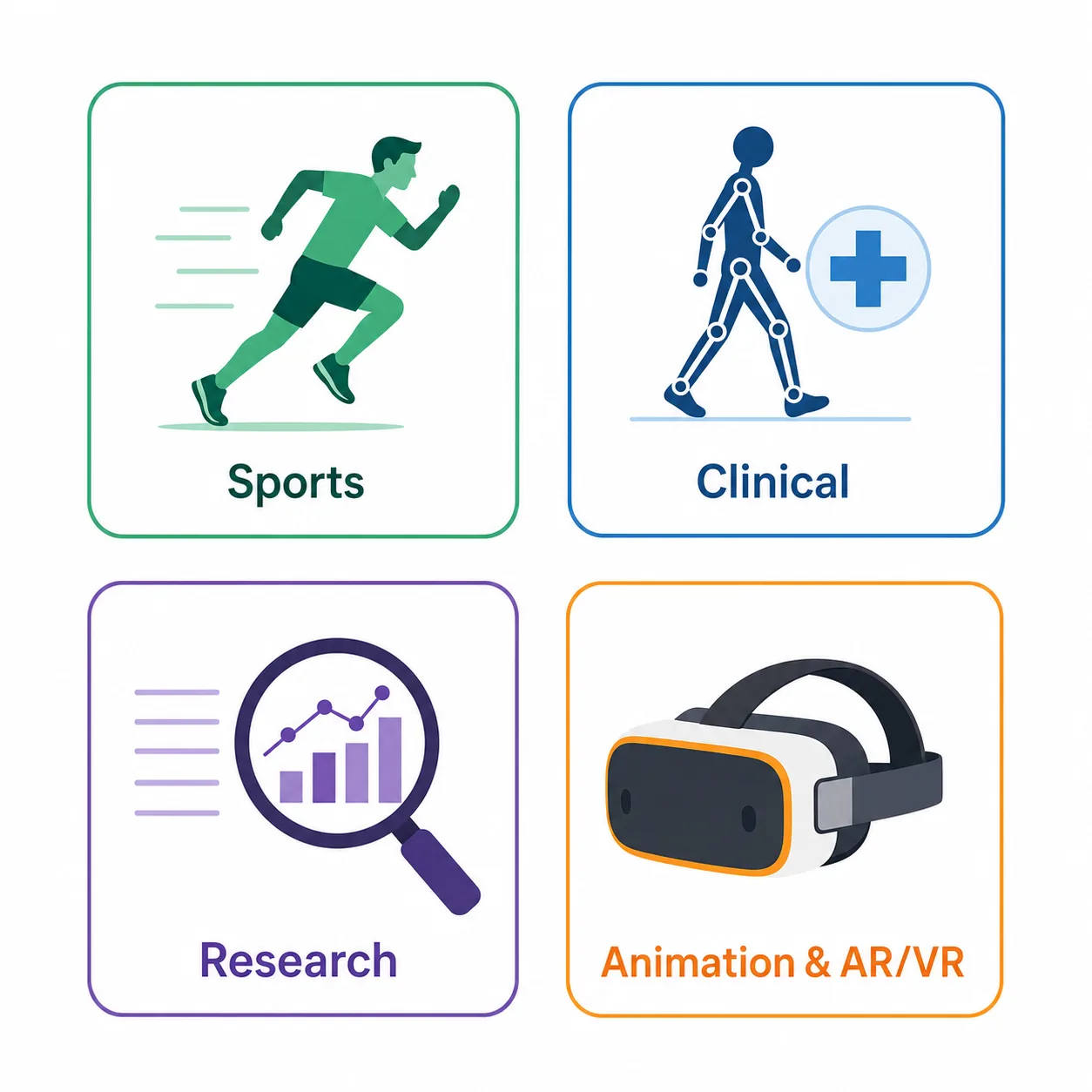
Sports performance and biomechanics
Coaches and sports scientists assess technique, movement load, and left-right asymmetry, often capturing athletes on the field or court instead of pulling them into a lab. For a breakdown of the full set of metrics a structured athlete screen reports, see our guide on what a biomechanical assessment measures.
Clinical and rehabilitation
Clinicians apply it to gait analysis, return-to-play decisions, and injury-risk screening, where the low setup burden makes repeated assessments practical.
Research
Removing marker placement lets researchers capture larger samples and study movement in more natural settings, improving the real-world relevance of findings.
Animation, film, and AR/VR
Studios use markerless capture to drive characters without suits. This is also where markerless augmented reality lives: an example of markerless AR is phone-based body or face tracking that anchors digital content to a person without any physical fiducial marker, unlike older marker-based AR that needed a printed pattern to lock onto.
A growing category of single-camera markerless motion capture apps brings a simplified version of this to a phone, trading some accuracy for convenience.
What do you need to get started? (software, hardware, requirements)
A markerless setup has three ingredients: cameras, compute, and software. Cameras range from a multi-camera lab array to a single smartphone. Pose estimation and reconstruction typically lean on a capable GPU, since deep-learning inference is computationally heavy. The markerless motion capture software ties it together, handling detection, 3D reconstruction, and biomechanical modeling.
Think of it as a spectrum. At one end sit research-grade multi-camera systems built for measurement accuracy; at the other, consumer apps built for speed and ease. Choosing among them is really a choice about how much precision your use case demands versus how much convenience you need.
Will AI replace motion capture? The future of markerless
AI is transforming motion capture rather than eliminating it. Markerless mocap is itself an AI-driven form of motion capture, so the real question is whether it will displace marker-based systems. For now, marker-based capture retains the edge in the most precision-critical work, but the accuracy gap is narrowing year over year as pose-estimation models improve.
The trajectory points toward more automation, better single-camera 3D reconstruction, and real-time feedback that turns capture into an immediate coaching or clinical tool rather than an after-the-fact analysis.
Frequently asked questions
What does markerless mean?
How does markerless motion capture work?
What is an example of markerless AR?
Will AI replace motion capture?
Is markerless motion capture accurate enough for clinical use?
Markerless motion capture lowers the barrier to measuring movement in real-world settings, letting athletes and patients move naturally while cameras and AI do the tracking. It already fits a wide range of sports-technology and biomechanics workflows, and as accuracy keeps climbing, its role in everyday movement analysis will only grow.