

Markerless motion capture quantifies human movement from ordinary video, using artificial intelligence to track the body, no suits, reflective markers, or wearable sensors attached to the subject. The practical difference is simple: the athlete or patient just moves while cameras roll, and AI does the measuring. It is a modern take on motion capture reinvented, and it is changing how coaches, clinicians, and researchers collect movement data outside the traditional lab.
Marker-based systems require dozens of reflective markers glued to precise anatomical landmarks and tracked by specialized cameras. Markerless flips that model, the intelligence moves from the subject to the software.
What is markerless motion capture?
Markerless motion capture (MMC) measures how a body moves through space without physically instrumenting the person. Standard or high-speed video cameras record the movement, and deep-learning models infer the position of joints and limbs directly from the pixels. The output is what biomechanists expect, joint angles, segment positions, timing, produced from video alone.
Because nothing is attached to the subject, sessions run faster and movement stays natural, which matters when you are measuring a sprint, a squat, or a child’s gait.
How does markerless motion capture work?
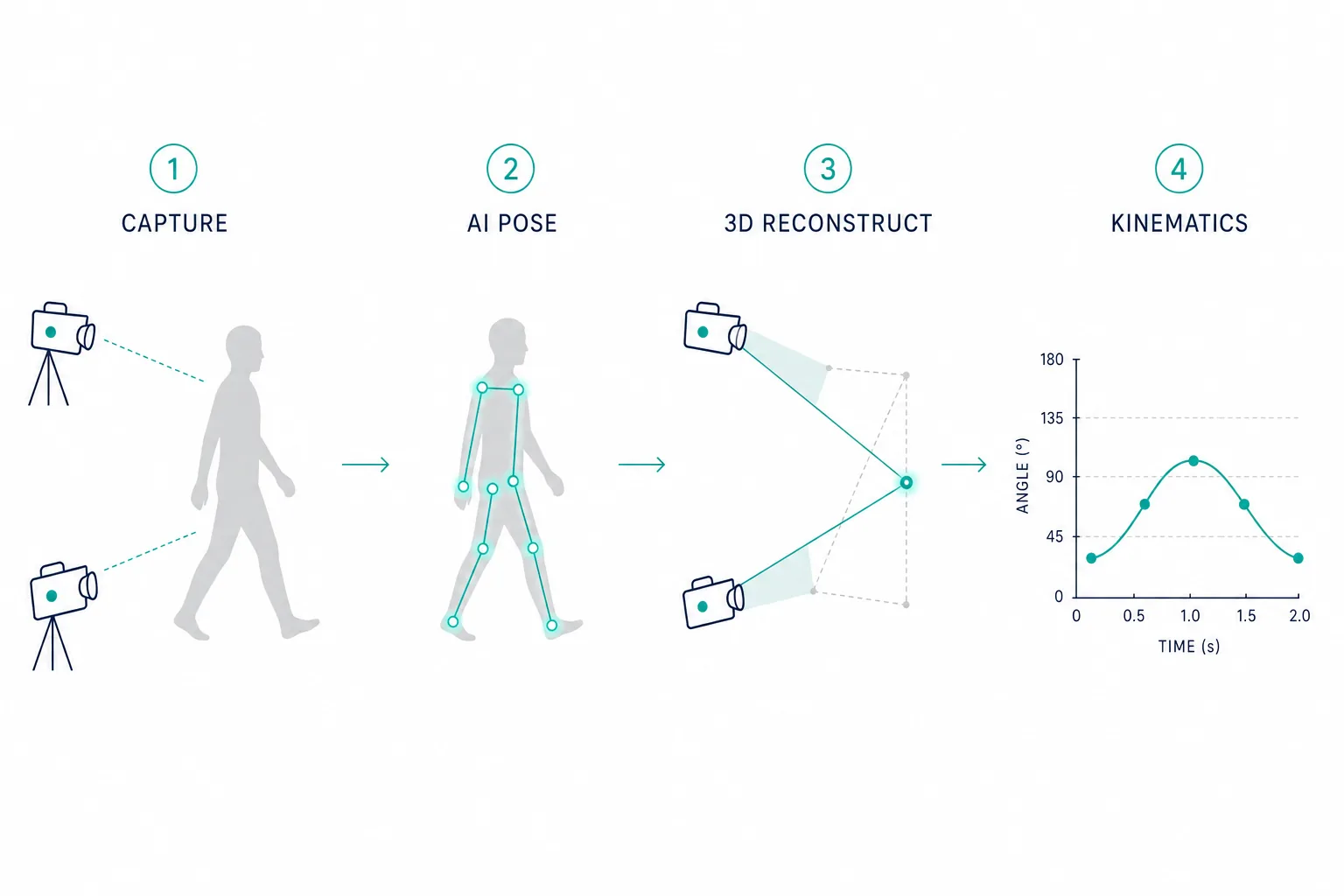
Capture
One or more synchronized cameras record the movement from different angles. More camera views generally mean more reliable 3D reconstruction, especially for occluded joints and rotational movement.
AI pose estimation
Deep neural networks, trained on large labeled image datasets, detect anatomical keypoints, hips, knees, ankles, shoulders, frame by frame. The field moved from hand-engineered computer vision to deep learning over the past decade, and that shift is what made accurate, automatic tracking possible.
3D reconstruction and kinematics
When multiple calibrated cameras see the same keypoint, the software triangulates its position in three dimensions. Stitched across frames, these positions yield 3D joint angles, angular velocities, and displacement over time. A 2023 study in Scientific Reports comparing markerless and marker-based systems shows how AI-driven reconstruction reproduces joint kinematics and where the two approaches diverge.
Markerless vs. marker-based motion capture
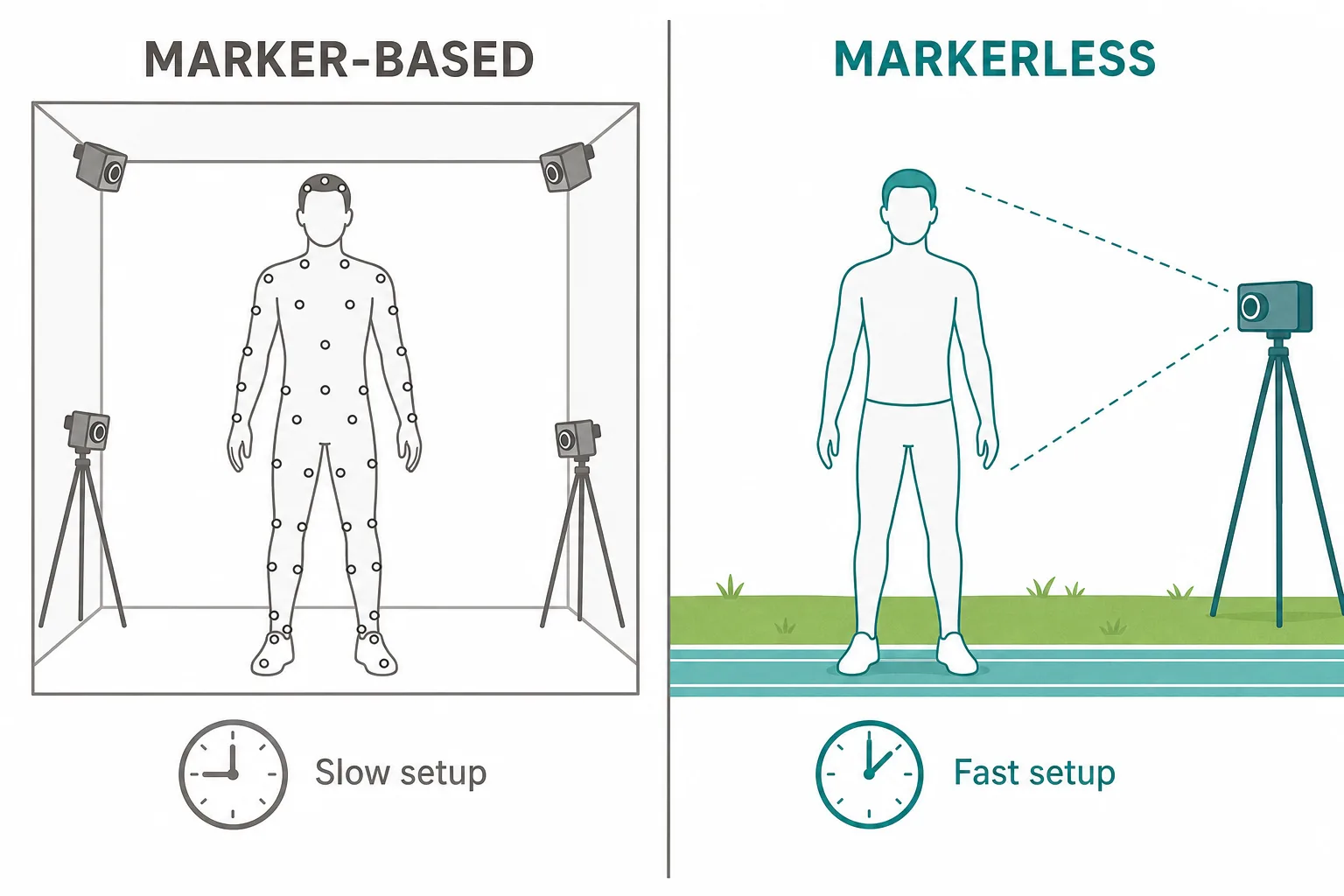
The two approaches trade off along a few clear dimensions:
| Factor | Marker-based | Markerless |
|---|---|---|
| Subject prep | Lengthy marker placement | None |
| Setting | Typically lab-bound | Lab or field |
| Soft-tissue artifact | Markers shift with skin | No skin-marker error |
| Setup time | High | Low |
| Established precision | Long validation history | Strong and improving |
Markerless removes two persistent error sources, inconsistent marker placement and skin movement over bone, but adds its own: sensitivity to camera setup, lighting, and occlusion. A comparison of marker and markerless motion capture presented through the International Society of Biomechanics in Sports documents where the two methods align and where they part.
How accurate is it? What the research shows
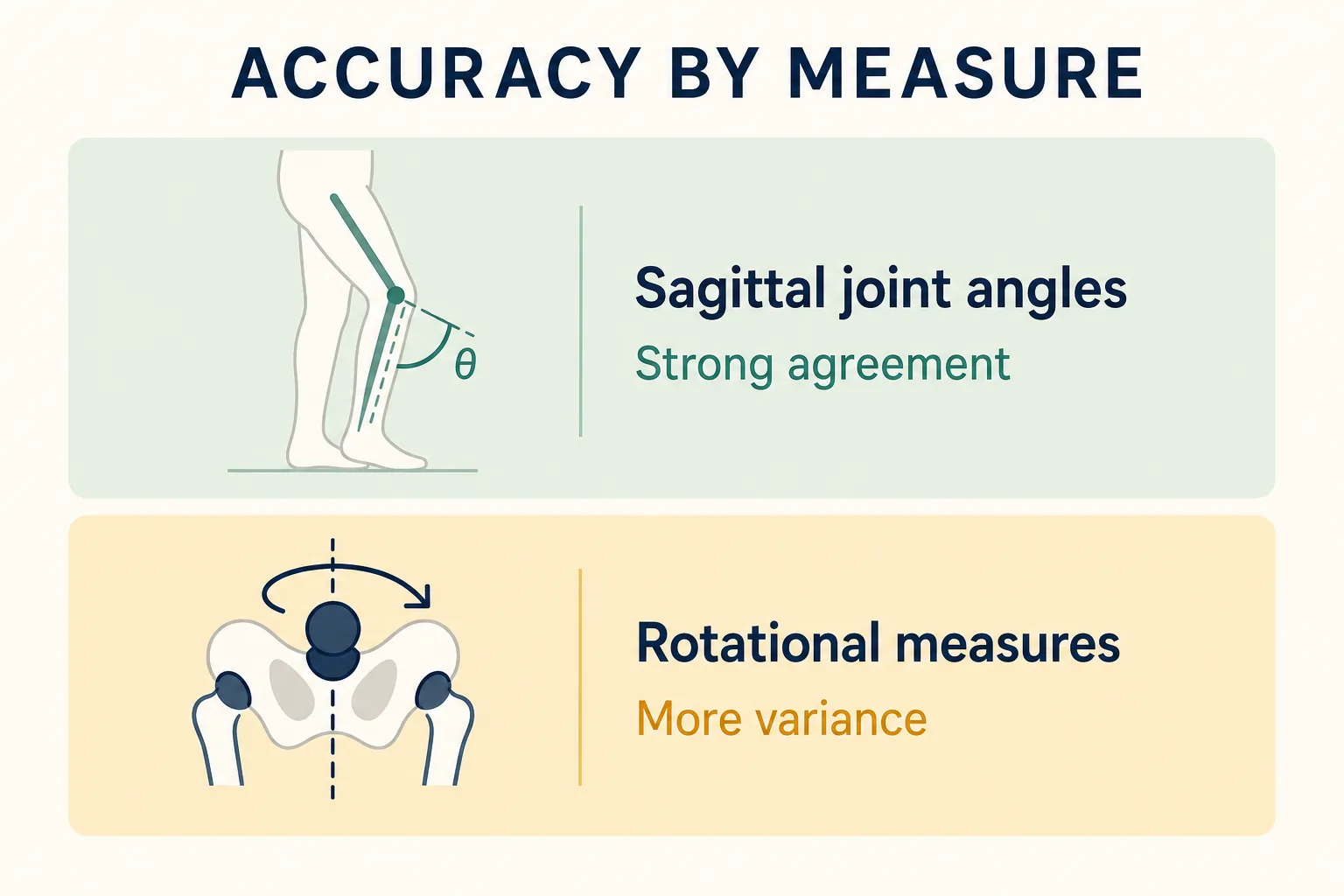
Accuracy decides adoption, and the honest answer is nuanced. Research consistently shows strong agreement between markerless and marker-based systems for large, sagittal-plane joint angles and for spatiotemporal gait parameters like step length and cadence. Agreement narrows for smaller joints and transverse-plane (rotational) measures, where a few degrees of difference can appear. A separate deep dive walks through what the accuracy research actually shows, study by study.
Work on the absolute reliability of gait parameters in Frontiers in Human Neuroscience reports encouraging reliability for many gait metrics, while research on markerless estimates of lower-extremity kinematics shows fidelity varies by joint and plane of motion.
Markerless is accurate enough for many performance and screening applications today, provided you match the metric you care about to what the system measures reliably.
Applications: sport, biomechanics, and clinical use
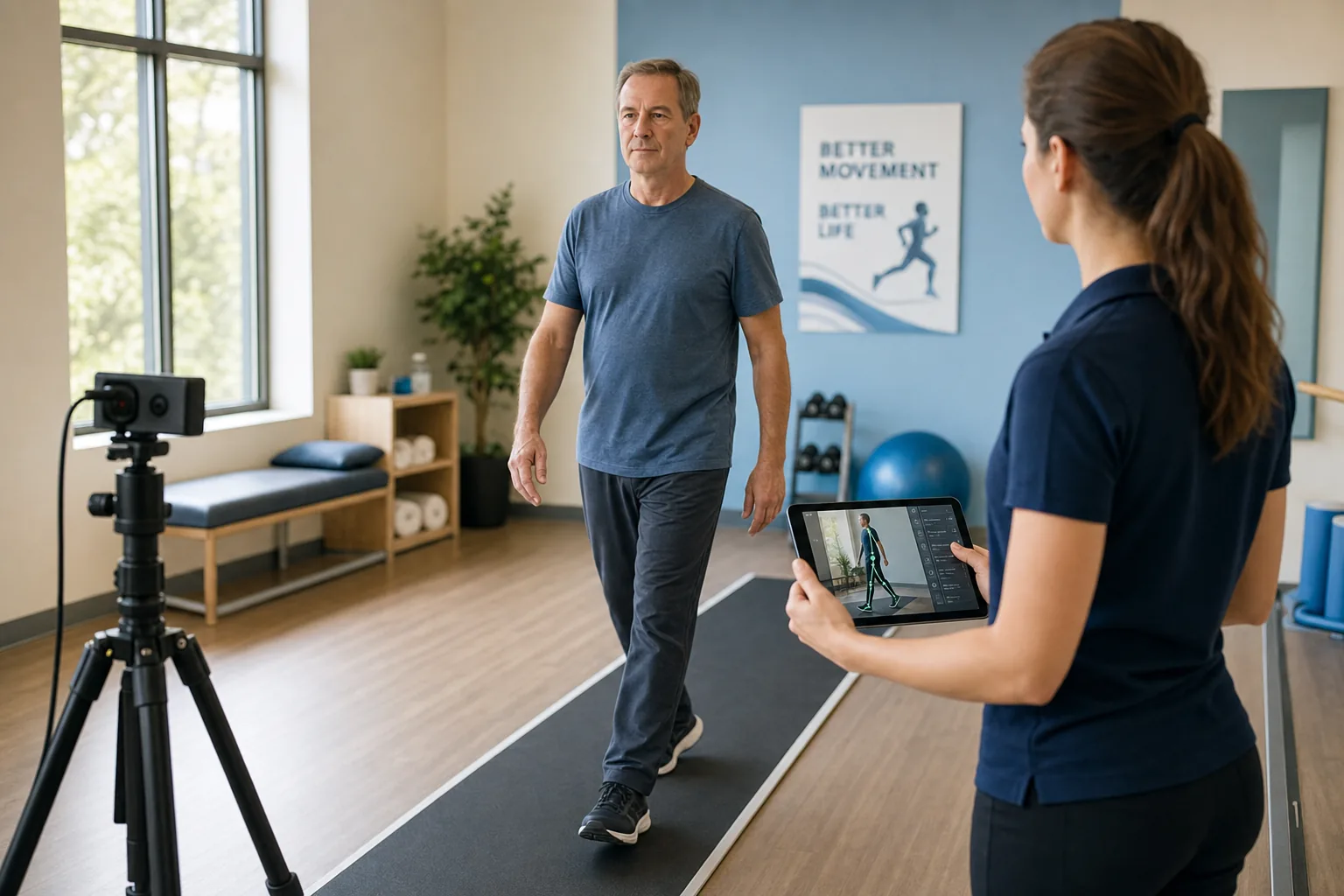
Sports performance and coaching
This is where markerless earns its keep. With no lab and no markers, athletes can be measured on the field, court, or track while moving the way they actually compete. Coaches get objective biomechanics, jump mechanics, sprint kinematics, landing patterns, without interrupting training, making it practical to test more athletes more often. If you are building a testing battery, our overview of the core metrics in athlete movement screening explains how each one feeds into staff decisions. For a worked example, our step-by-step countermovement jump protocol covers setup, the key output metrics, and how to interpret each result.
Clinical and rehabilitation use
Clinicians use markerless capture for gait analysis, movement screening, and return-to-play decisions after injury. A systematic review of markerless motion capture applications catalogs its growing use across clinical and research settings, reflecting confidence that video-based measurement can support real decisions when applied within its validated limits.
Software, apps, and cost: what to expect
Software and apps
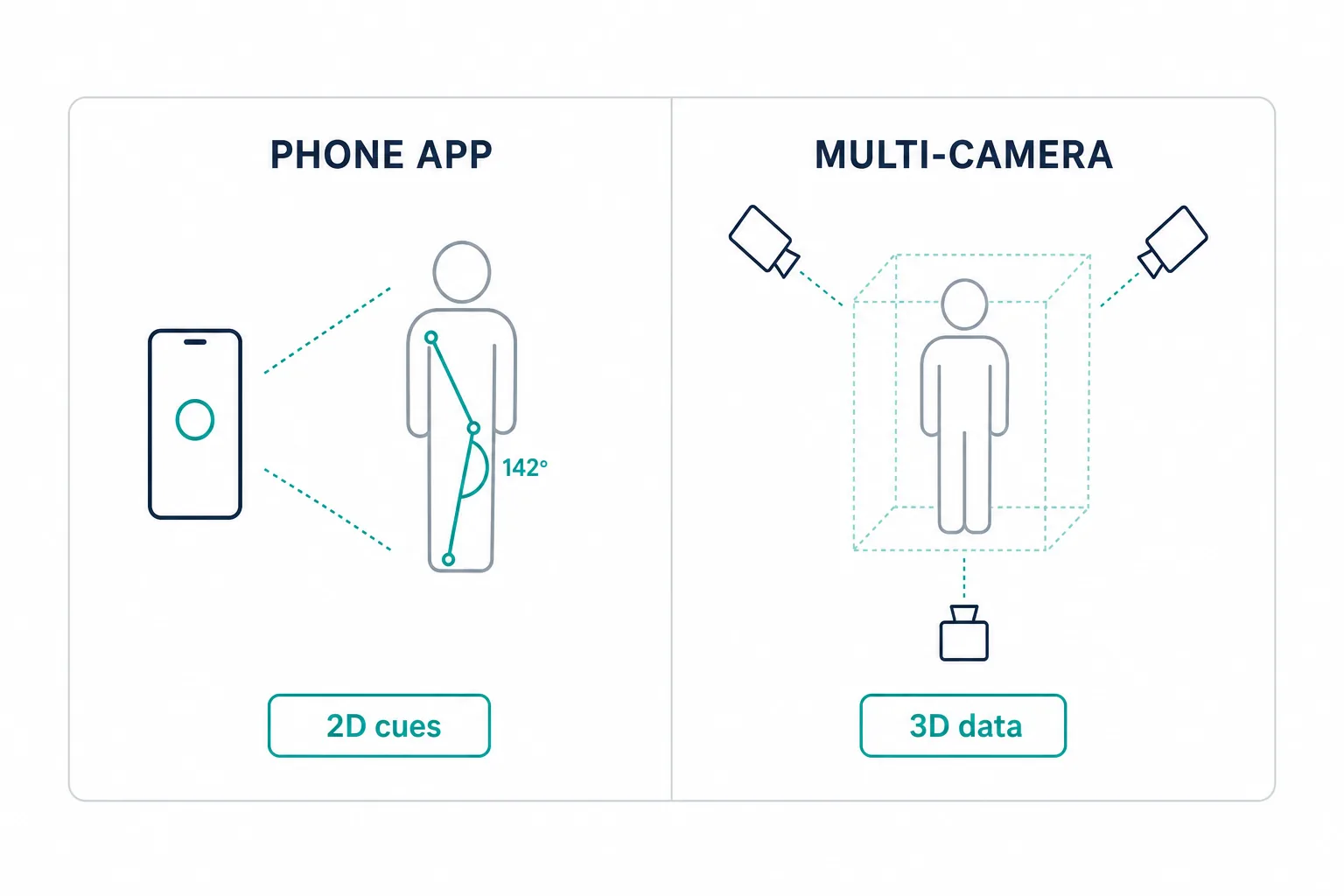
Markerless software spans a wide range. Multi-camera research systems produce full 3D kinematics for biomechanics analysis. Single-camera phone-based apps are more accessible and useful for quick 2D feedback, but one view limits true 3D accuracy and rotational measurement. Choose based on whether you need directional, coaching-level cues or research-grade 3D data.
Free and open-source options
Free, open-source pose-estimation tools exist and have driven much of the field’s academic progress. They offer flexibility and transparency but demand technical setup, calibration expertise, and validation before their output can be trusted for decisions, costs that are real even when the software is free.
Pricing factors
There is no single markerless motion capture price, and any figure quoted without context misleads. Cost is driven by camera count and quality, the software licensing model, the accuracy and validation you require, and ongoing support and training. A single-camera app and a validated multi-camera 3D system sit at opposite ends of that spectrum. Define your accuracy and workflow needs first; the budget follows.
What to look for when choosing a system
- Camera coverage, enough views for the movements and joints you measure
- Validated accuracy, published or documented agreement for your key metrics
- Workflow speed, how fast you go from capture to usable data
- Environment, indoor, outdoor, and field-of-play flexibility
- Data export, open formats that fit your analysis pipeline
- Support and training, help getting reliable results, not just software
The future of markerless motion capture
The trajectory points toward more capable single-camera 3D estimation, real-time feedback during training, and wider access as hardware requirements drop. Research into the applicability of markerless motion capture for clinical use signals steady movement toward everyday deployment. The larger story is the democratization of biomechanics: measurement that once required a dedicated lab is moving to the places where people actually train, work, and recover.